Building damage
insurance
You are having a house, an extension or an extra storey built, and your bank or notary is asking for the « DO » certificate? Building damage insurance (assurance dommages-ouvrage) is the only construction insurance the law requires of the owner themselves. Here is what it is for, when to take it out, what it covers for ten years, how a claim works and what you risk without it.
What building damage insurance is for
When a new house cracks badly or a roof lets water in three years after the end of the works, the law names those responsible: the builders, bound by the 10-year structural guarantee. But it still has to be established which one is at fault. Between the mason, the carpenter and the roofer, expert assessments and court cases can take years, during which the damage gets worse.
Building damage insurance, often called « DO », means you do not have to wait. It pays for repairs to damage falling under the 10-year guarantee without first establishing who is responsible, and the insurer then recovers the cost itself from the builders and their insurers. That is the purpose of Article L242-1 of the French Insurance Code: fast pre-financing, for the benefit of the owner.
| Building damage insurance | 10-year structural guarantee | |
|---|---|---|
| Who takes it out | The client: you, the owner having the building built or renovated | Each company working on the building |
| When | Before work starts on site | Before starting business, with the certificate attached to its quotes and invoices |
| What it does | Pre-finances repairs without waiting for a responsible party to be named | Covers the company's liability for damage falling under the 10-year guarantee |
| Duration | 10 years from handover | 10 years from handover |
| If the property is sold | Passed on to the new owner | The company's liability continues to run |
So the two policies do not overlap. The 10-year guarantee protects the builder against its own liability; building damage insurance saves you from paying for repairs up front and fighting the dispute on your own. How roles are shared between the owner and the builders is explained in our article project manager or client.
Who must take it out, and for which works
The client. The obligation falls on any person, natural or legal, who has construction work carried out as the owner, seller or agent of the owner. Service-Public adds the co-ownership managing agent and the property developer. For a house, that means you, not the builder or the project manager.
The works concerned. This means construction work, which goes well beyond a new house. Service-Public gives as examples structural alterations, major exterior works, foundations, earthworks and façade work that keeps the building watertight. An extension, adding a storey or the major refurbishment of a barn are included as soon as they involve the structural work, the roof structure or the building envelope.
Borderline cases. For finishing work alone, with no work on the structure or on watertightness, the question arises. Rather than deciding on your own, send the description of the works to an insurer: it is for the insurer to say whether the works fall under compulsory insurance.
When to take it out: before the first spadeful of earth
The law sets a single deadline: before work starts on site. In practice, the process begins as soon as the quotes are signed or about to be, because the insurer reviews a complete file before offering a policy.
What the insurer asks for. Requirements vary from one insurer to another, but the file always rests on the description of the building, its cost and the companies carrying out the work. Service-Public recommends gathering, before work starts, the 10-year structural guarantee certificate of each company and its insurer's contact details: you will need them if there is a claim. Since the law of 6 August 2015, these certificates must also be attached to professionals' quotes and invoices (Article L243-2 of the French Insurance Code).
If nobody will insure you. You are free to choose your insurer. If all those you approach refuse, you can refer the matter to the Bureau central de tarification (central pricing office): it sets the premium that the insurer of your choice will be required to apply.
A realistic schedule allows for this review time just as it does for the processing of the permit. Our guide to the building permit sets out the other costs that follow the authorisation.
What it covers, and for how long
The damage covered. The same as under the 10-year guarantee: damage that undermines the soundness of the building or makes it unfit for its intended use, such as a major structural crack or a roof collapse. Added to this is damage to inseparable equipment, items that cannot be removed without damaging the building: built-in pipework, ceilings, floors, central heating, door and window frames, embedded electrical networks.
What is not covered. Fraud or intentional misconduct, normal wear and tear, lack of maintenance or abnormal use, as well as external causes: force majeure, the act of a third party or the owner's own fault. A fine shrinkage crack with no effect on soundness does not fall within this scope either; our guidance on assessing a crack in a house helps tell the difference.
Duration. Cover runs for ten years from the handover of the works. In principle it applies once the completion guarantee has expired, that is one year after handover: during this first year, it is the builder who must put right the defects reported. Building damage insurance can nevertheless come into play earlier in two cases:
Before handover, if the builder does not finish or does not carry out repairs despite formal notice that has had no effect, and its contract is terminated for non-performance.
During the completion guarantee year, if the builder, having been given formal notice, does not repair the defects reported.
Hence the importance of a formal handover recorded in a dated and signed report: it is the handover that starts the time limits running.
If there is a claim: notification and the insurer's deadlines
Notifying the claim. The claim is made by recorded delivery letter with acknowledgement of receipt, by electronic registered mail or by delivery against a receipt. It must be made no later than two years after the damage occurs or after you became aware of it; beyond that, the right to compensation is lost. Service-Public provides a template claim letter.
The deadlines imposed on the insurer run from receipt of the claim, in calendar days:
| Step after the claim is notified | Insurer's deadline |
|---|---|
| Request missing documents | 10 days |
| Have an expert assessment carried out and say whether it accepts the claim | 60 days |
| Present the compensation offer | 90 days (up to 135 days in case of exceptional difficulty, with your written consent) |
| Damage under €1,800: reply and make an offer, with no compulsory expert assessment | 15 days |
| Pay once the offer has been accepted | 15 days |
If the insurer does not meet its deadlines, you can, after informing it by recorded delivery, have the repair work carried out yourself. The compensation due is then increased by interest at twice the statutory interest rate. No excess may be left for you to pay.
If the offer seems insufficient to you and the work cannot wait, you can ask for an advance of at least three quarters of the amount offered, paid in one go within fifteen days and deducted from the final compensation. The sums received must be used to actually repair the building.
Building without building damage insurance: what you risk
Criminal liability. Failing to take out compulsory construction insurance is punishable by six months' imprisonment and a €75,000 fine under Article L243-3 of the French Insurance Code. The same article rules out these penalties for an individual who builds a home to live in themselves or for occupation by their spouse, parents or grandparents, or children. The exemption applies to the penalty, not to the obligation.
In practice. Without building damage insurance, serious damage forces you to identify the responsible builder yourself, to have the damage formally recorded and, if the builder disputes it, to wait for a court decision before being compensated by its 10-year guarantee insurer. Urgent repairs have to be paid for out of your own pocket.
On resale. If the property is sold less than ten years after the works, the deed must state whether or not the compulsory insurance policies were taken out, and the certificates are attached to it (Article L243-2). The buyer therefore finds out about the lack of building damage insurance before signing, and the issue comes up in the price negotiation. Conversely, a DO policy that has been taken out goes with the property and benefits the new owner.
The price of building damage insurance
No premium is set by law, and Service-Public publishes no premium amount. Each insurer sets its own on the basis of the file: the nature of the building, the cost of the works, the companies involved and the documents supplied. The figures circulating online therefore only apply to the projects that produced them, and we will not give you one at random.
To compare usefully, send the same file to several insurers and check what each proposal covers: the new work alone, or also the existing structures affected by the works in the case of an extension or a renovation. Finally, remember to include the premium in the project budget, alongside fees, taxes and utility connections; our guide to the price of a chalet in Haute-Savoie lists it among the costs to plan for outside the works.
What we provide for your file
Building damage insurance remains your policy: you take it out, with the insurer of your choice. Our role is to give you a file the insurer can review without back-and-forth.
As a general contractor, we carry out the work with our own teams, each in its own trade. So you only have one quote, detailed trade by trade, to send, together with our 10-year structural guarantee certificate, instead of a pile of quotes and certificates to collect company by company. The plans and the description of the building come from the design, done in-house. At the end of the works, handover is recorded in a dated and signed report, which sets the starting point of the guarantees. How we work as a general contractor is explained in detail in a dedicated article.
Our projects around the lake
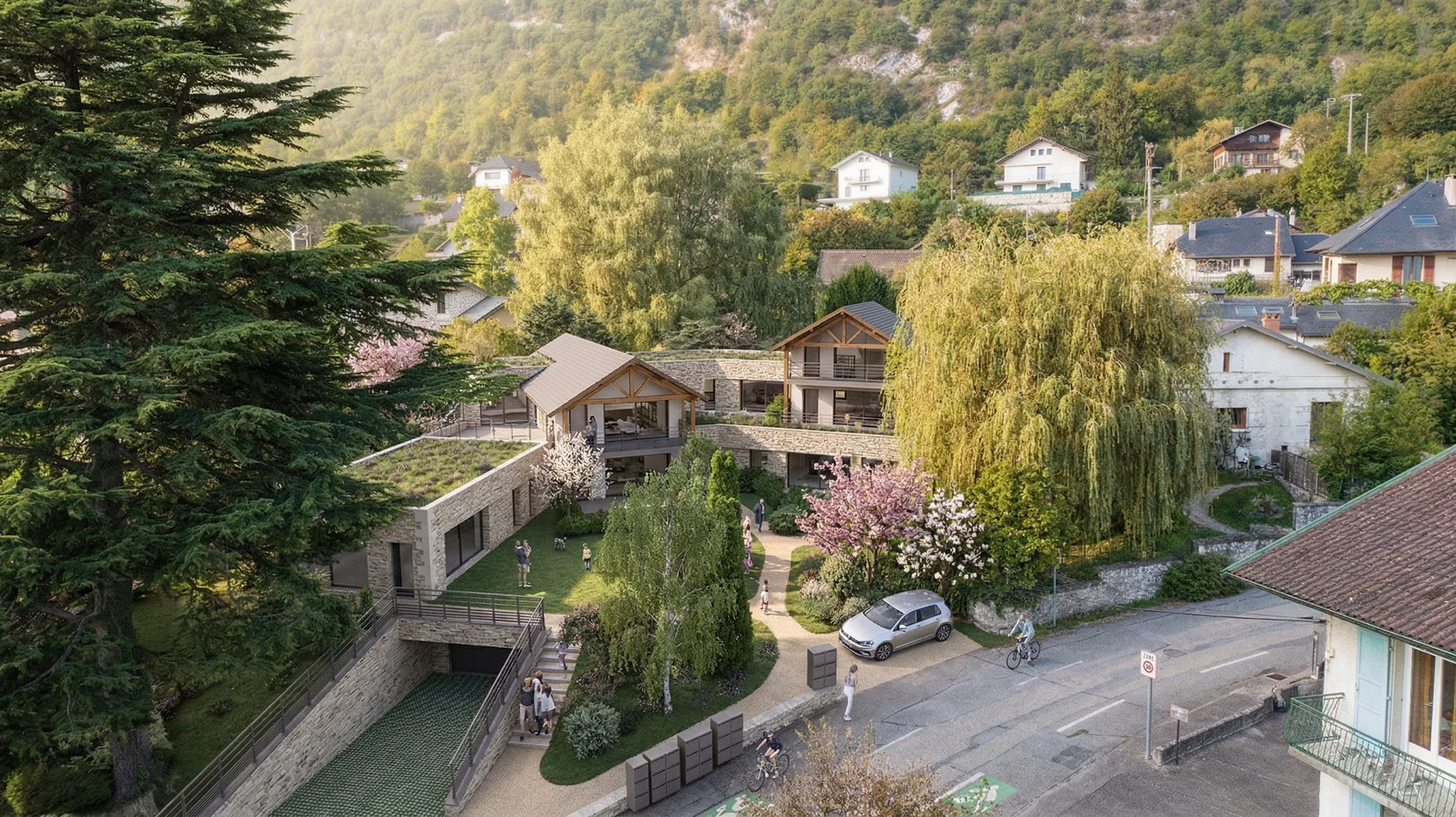
All projects →A few projects by our teams, from the shores of Lac du Bourget to the Val d'Arly.
A file ready for the insurer
Design, quote and works with a single point of contact: the documents for your building damage insurance come from one source.
Plans and specification
The building described as it will be built, from our design.
A single detailed quote
Every trade priced line by line, from earthworks to finishes.
10-year guarantee certificate
Attached to the quote and invoices, as the French Insurance Code requires.
Our own teams
Masonry, plastering, painting, joinery: salaried craftsmen, each in their own trade.
Formal handover
A dated and signed report, the starting point of the guarantees.
After-works follow-up
A single point of contact during the completion guarantee year.
Where we work
New builds, extensions and renovations from Aix-les-Bains and Annecy, across both Savoie departments.
Frequently asked questions · Building damage insurance
A complete file
before the first spadeful of earth.
Free visit and quote: design, a quote detailed trade by trade and our 10-year guarantee certificate, so you can prepare your building damage insurance with peace of mind.