Changing your heating:
what to replace oil with.
An oil boiler at the end of its life, a bill that keeps climbing, an energy performance rating (DPE) that blocks a sale or a letting: there are many reasons to change your heating. The right question is not “which appliance”, but “in what order”. Here are the steps of a successful replacement, the solutions that hold up through a Savoie winter, what they cost on our quotes and the 2026 grants.
What the regulations have changed for oil
Since 1 July 2022, decree no. 2022-8 of 5 January 2022 has set a greenhouse gas emissions ceiling for any heating or hot water equipment installed in a home, new or existing. In practice, this ceiling rules out the installation of a new oil or coal boiler. The Ministry for Ecological Transition states it clearly: a boiler already in place can keep running, be serviced and be repaired. Nothing obliges you to rip it out tomorrow; it is replacing it like for like that is no longer possible.
Two other rules weigh on the choice. Since 1 March 2025, the supply and installation of a fossil-fuel boiler, gas included, is subject to 20% VAT, whereas a heat pump with no fossil-fuel back-up stays at 5.5%. And in a detached house, a major renovation (rénovation d'ampleur) funded by MaPrimeRénov' can neither include nor keep oil, gas or coal heating. Replacing oil with gas remains permitted, but it is the solution that closes the most doors.
Step 1: look at the house before the appliance
A heat generator is sized on the house's heat losses: what it loses through the roof, walls, floor, windows and renewed air. Changing the heating before insulating means buying a machine calibrated for a house that will no longer exist after the insulation work: too powerful, more expensive, and less efficient because it will run in fits and starts.
In practice, we start from the energy performance rating (DPE) or an energy audit where one exists, then check on site the insulation of the roof, walls and ground floor, the condition of the joinery and the ventilation. If insulation is needed, it is priced first: the roof first, often through loft insulation, then the walls, from the inside or the outside. The heating is then calculated on the insulated house, even if the two jobs are a few months apart.
Ventilation is part of the same reasoning: a better-insulated and more airtight house must renew its air in a controlled way. The cost of simple or dual-flow ventilation is detailed in our guide to the price of mechanical ventilation (VMC).
Step 2: choose the system that suits your home
The air-to-water heat pump is the most direct replacement for an oil boiler: it connects to the existing radiator network or underfloor heating and also produces domestic hot water, often with a built-in cylinder. It is the only solution on this list that qualifies for the MaPrimeRénov' per-measure (par geste) flat rate in 2026. Its price and variants are detailed in our guide to the price of an air-to-water heat pump.
The air-to-air heat pump heats through wall-mounted indoor units or a ducted network, and cools in summer. It does not produce hot water and does not reuse water radiators: it is justified when the existing system has to be redone, or in a flat. Since the order of 13 July 2026, it may qualify for 5.5% VAT subject to performance conditions.
The pellet or wood stove suits as the main heating of a compact, well-insulated house whose rooms communicate. It needs a flue, space to store the fuel and a little attention. To heat a whole large house with wood through its radiators, you need a pellet boiler instead, with a silo.
Electric radiators cost little to install but a lot to run: they hold their own in a small, very well-insulated home, or as an occasional supplement, rarely as a replacement for a boiler in a Savoie house.
Hot water is dealt with separately when the new heating does not produce it: a heat pump water heater, which recovers heat from the ambient air of a garage or cellar, uses markedly less than a conventional electric cylinder.
Step 3: sizing for the Savoie winter
The output calculation starts from the commune's design outdoor temperature, that is, the lowest temperature at which the heating must still be sufficient. It drops with altitude: the same house does not call for the same output on the shore of Lac du Bourget and in a village in the Bauges or the Aravis. A heat pump chosen from a catalogue, without this calculation, is the first cause of pumps that struggle in severe cold and switch to their electric element.
The radiators in place decide the rest. Cast-iron radiators sized for an oil boiler call for high-temperature hot water: the heat pumps we most often install deliver water up to 60°C, which is enough if the house has been insulated. Otherwise, a few radiators are enlarged or replaced, or a high-temperature model is chosen. Underfloor heating, for its part, works at low temperature and makes the heat pump more efficient.
Finally, the outdoor unit is placed away from snow falling off the roof, raised on a plinth, with a condensate drain that does not freeze, and at a distance from bedrooms, yours as well as the neighbours'. Depending on the commune's local plan (PLU) and in a protected area, fitting it on a facade may require a prior declaration (déclaration préalable).
Step 4: removing the old installation and the tank
The oil boiler is removed and taken away, the radiator network drained, flushed (désembouage) and rinsed: sludge accumulated over decades is enough to degrade the performance of a new heat pump. The freed-up boiler room often houses the indoor unit and the cylinder.
The oil tank is emptied of its remaining oil, degassed and cleaned, then cut up and removed, or neutralised in place when it is buried and cannot be taken out. This removal qualifies for its own MaPrimeRénov' flat rate in 2026. We prefer to say it frankly: our recent quotes do not contain enough tank removals to publish a range, so we price it case by case after seeing its access and its volume.
The old boiler's flue is not necessarily lost: if it is in good condition, it can be lined to connect a stove or a pellet boiler. A heat pump does not need one.
Step 5: installing, connecting, commissioning
On our jobs, it is our own craftsmen, each in their own trade, who carry out the whole job: the heating engineers and plumbers fit the outdoor unit, the indoor unit, the cylinder and the hydraulic connections; our electricians create the dedicated circuit at the panel and check whether the supply capacity needs to be increased; our masons and plasterers build the plinth, the wall penetrations and the casings. A site manager follows the work from start to finish.
Commissioning includes setting the weather-compensation curve (loi d'eau), which adjusts the temperature of the water sent to the radiators according to the outdoor temperature, balancing the system and handing over a clear manual. A heat pump of 4 to 70 kW must then be serviced at least every two years by a professional, who in particular checks the tightness of the refrigerant circuit: this is an obligation of the environment code since the decree of 28 July 2020.
For the order of operations: visit and survey, detailed quote, filing of the grant application before any start (MaPrimeRénov' is applied for before the work starts), then the job. The ideal is to replace the installation outside the heating season, so as never to leave the house without heat.
What each solution costs on our quotes
The ranges below are a survey of our 2024-2026 quotes in Savoie and Haute-Savoie, rounded and excluding tax. They give an order of magnitude, not a price for your house: the output, access, the condition of the existing system and ancillary work make the difference.
Air-to-water heat pump, heating and hot water, supplied and fitted: €14,000 to €26,000 excl. VAT when the existing radiators are kept, over €30,000 excl. VAT when the heating network is redone (8 fixed-price quotes across 7 projects). The detail is in our guide to air-to-water heat pump prices.
Air-to-air heat pump with several wall units (2 to 7): €6,500 to €12,000 excl. VAT for the installation line, most often around €8,000 excl. VAT (15 projects); fitting is sometimes priced separately. A ducted system serving a whole house runs from €22,000 to €25,000 excl. VAT (only 2 projects).
Pellet stove fitted with its flue: €6,300 to €7,500 excl. VAT. This survey rests on only 5 projects: take it as a guide.
240-litre thermodynamic water heater: €2,300 to €3,100 excl. VAT for the unit alone (5 projects), with fitting added depending on the location. A standard electric water heater of 100 to 200 litres costs from €600 excl. VAT for the unit to €1,500 excl. VAT fitted, including removal of the old one (14 projects).
Electric radiators: €220 to €1,150 excl. VAT each, fitted, depending on the technology and the output (8 projects). A new network of water radiators, pipework included, cost €5,100 to €6,700 excl. VAT on the only two projects where we priced it.
To convert to prices including VAT, the rate depends on the equipment: 5.5% for a heat pump without fossil-fuel back-up, i.e. about €21,100 incl. VAT for €20,000 excl. VAT, 20% for a gas or oil boiler. The full rules are in our guide to VAT on renovation work.
2026 grants for getting off oil
MaPrimeRénov' per measure funds, in 2026, the air-to-water heat pump, the geothermal heat pump and the removal of the oil tank, for a home occupied or let as a main residence. The user guide published by Anah in September 2026 gives these flat-rate amounts: air-to-water heat pump €5,000 for very low incomes, €4,000 for low incomes and €3,000 for intermediate incomes; tank removal €1,200, €800 and €400; geothermal heat pump €11,000, €9,000 and €6,000. MaPrimeRénov' and CEE combined cannot exceed 90%, 75% or 60% of the amount including VAT depending on these three categories. For replacing oil heating, the house must be at least two years old, compared with fifteen years in other cases.
Households with higher incomes do not have access to the per-measure flat rate: they go through the energy saving certificates (CEE). The Coup de pouce Chauffage (heating boost scheme) increases these premiums when an oil, gas or coal boiler is replaced, in particular, by an air-to-water heat pump or a biomass boiler. Since 1 January 2026, the old minimum amounts no longer apply: compare the offers of several energy suppliers before signing.
The pellet stove and the thermodynamic water heater are not in the 2026 per-measure flat rates; they remain fundable within a major renovation, which combines at least two insulation measures. These grants require an RGE contractor for the work concerned. Our RGE CertiRénov certification (no. CR-2026-73-0095) covers the overall renovation offer, the one that brings together heating, insulation and ventilation: for a heating change on its own, we check with you, before signing, what is eligible. The detail of the scales is in our MaPrimeRénov' 2026 guide, to be cross-checked on france-renov.gouv.fr at the time of the project.
Our projects around the lake
All projects →Complete renovations where the heating was rethought together with the insulation, from the Aix basin to the Val d'Arly.
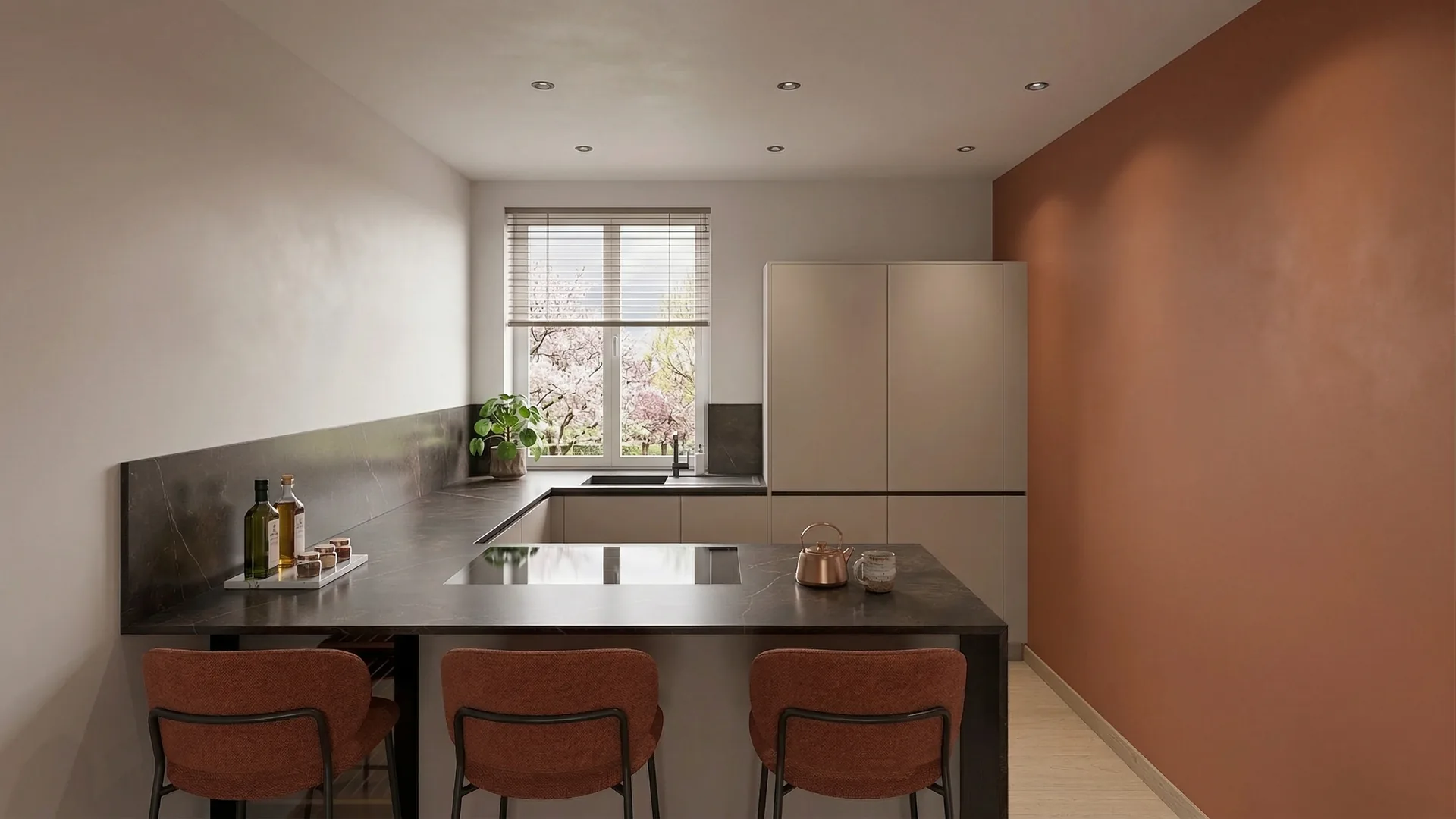
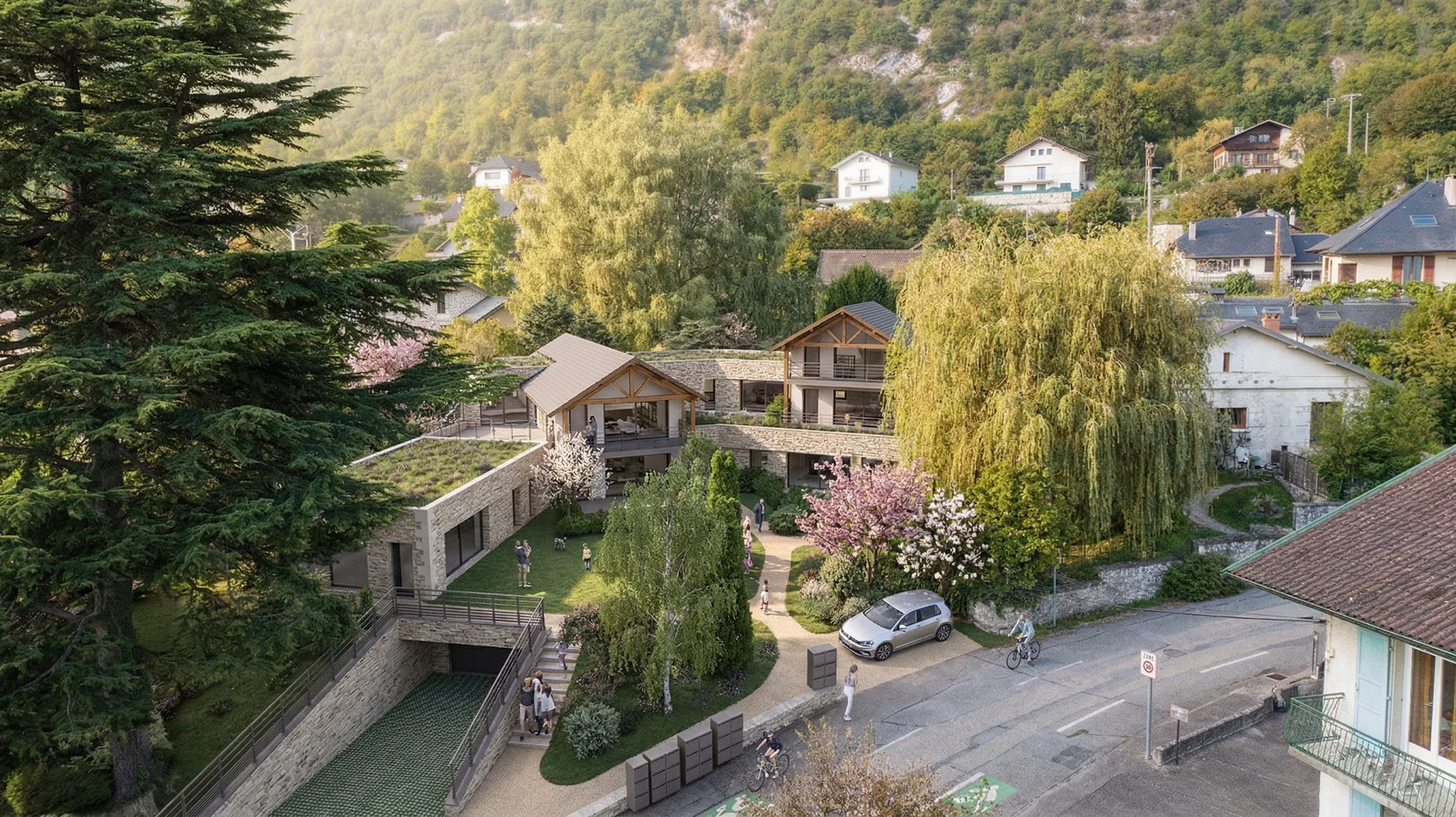
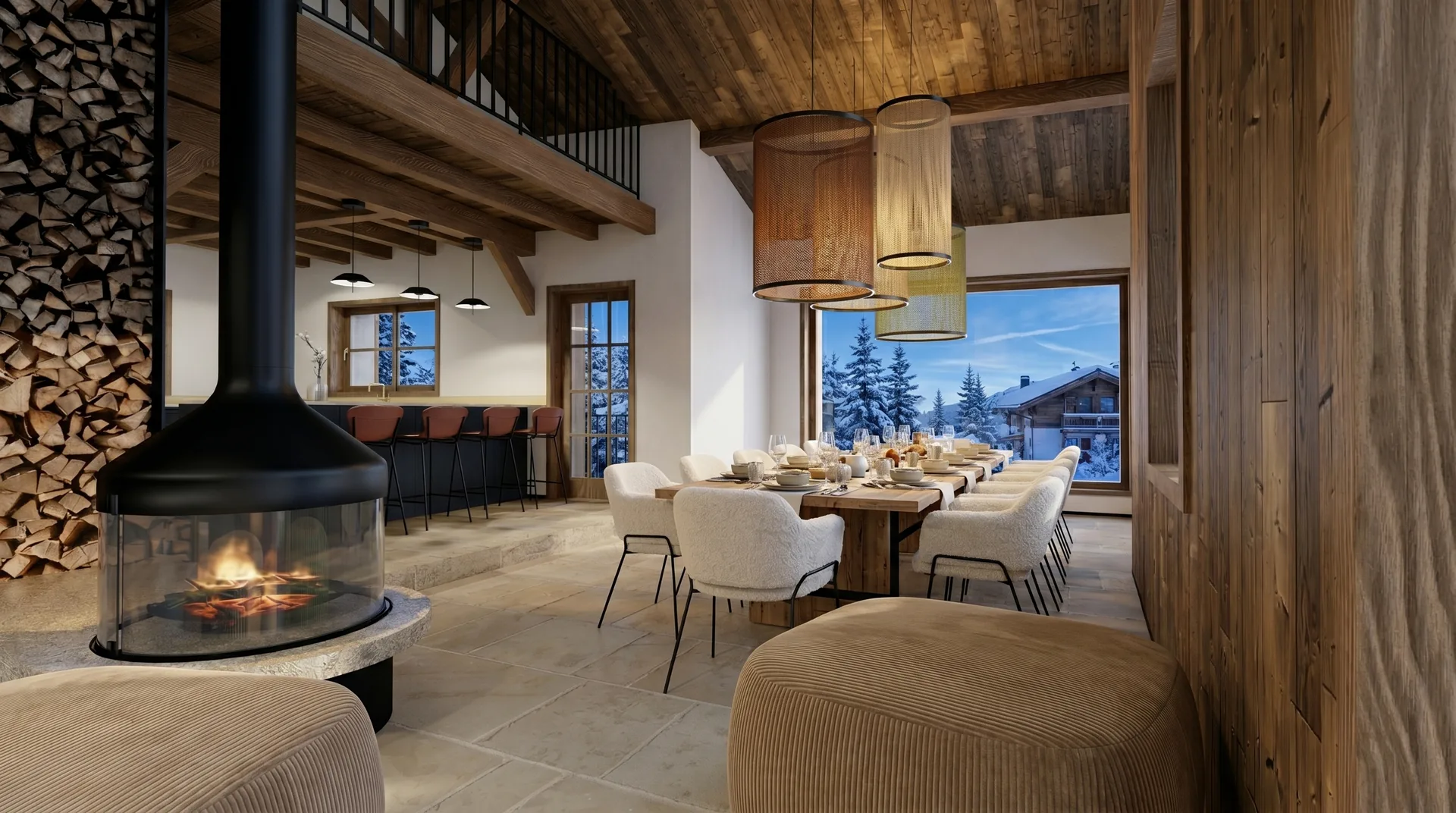
How we price a heating change
An on-site survey, a power calculation, a quote that separates the unit, the fitting and the work around it.
Survey of the existing building
Boiler, tank, radiators, flue, electrical panel, insulation: we note what is kept and what is replaced.
Heat loss calculation
Output is calculated room by room on the design temperature of your commune, not on the floor area.
Comparison of solutions
Heat pump, wood, electric: purchase cost, running cost and grants set side by side for your house.
Quote item by item
Unit, fitting, removal of the old one, tank, electrics, masonry: each line priced separately, so you can compare.
Grant application upstream
We state in the quote which grants apply and when to apply for them, before any work starts.
A single point of contact
Heating engineers, plumbers, electricians and masons from our own teams, one site manager, a single contract.
Find out more
- Cost of a chimney flue lining
- Price of a fitted pellet stove
- Price of a thermodynamic water heater
- Cost of an air-to-water heat pump
- Price of a heat-recovery ventilation system (VMC double flux)
- Insulating an unconverted loft: the guide
- Ground floor insulation: the guide
- MaPrimeRénov' and the 2026 grants
- VAT on renovation work
- Energy rating F: what changes for letting
- Our craftsmen, each in their own trade
- Our RGE CertiRénov certification
- Request a free quote
Where we work
Visits and quotes for heating replacement from our offices in Aix-les-Bains and Annecy.
Frequently asked questions · Changing your heating
A power calculation,
not a catalogue.
Free visit, survey of the installation and quote: you will know which system suits your house, what it costs and what the grants cover.