Which insulant
to choose?
Mineral wools, wood fibre, cellulose, polyurethane, polystyrene, cork, hemp: each family has its supporters, and none wins everywhere. An insulant is chosen wall by wall, according to the space available, the substrate, water vapour and summer heat. Here is our teams' method, backed by data-sheet figures.
There is no best insulant, only a wall to insulate
What stops heat is the thermal resistance R, expressed in m²·K/W. It is calculated from the installed thickness and the conductivity of the material, written λ: R = thickness ÷ λ. Two very different insulants can therefore reach the same R; one simply needs a few centimetres more. Once that R is reached, your heating does not tell the difference between a wool, a plant fibre and a foam.
The differences lie elsewhere: the space you have, the way the wall removes moisture, the heat that passes through a roof in July, fire resistance, noise, and the price once fitted. From one wall to another, these criteria do not weigh the same at all. This is why, to the question "what is the best insulant?", we always answer with another: to insulate what?
The level to reach, for its part, does not depend on the material. Our guides by wall detail it: R ≥ 7 for unconverted lofts, R ≥ 6 under roof slopes, R ≥ 3.7 for a wall and R ≥ 3 for a ground floor.
Insulant families, data sheet in hand
Each value in the table comes from the data sheet of a specific product, consulted in writing this guide. The same material comes in several grades: the figure that counts is that of the product written on your quote, with its ACERMI certificate when it has one.
| Family | Product consulted and conductivity λ | Water vapour (μ) | Reaction to fire | Where it belongs |
|---|---|---|---|---|
| Glass wool | GR 32 Nu (Isover): 0.032 | 1 | A1 in bare form | Framed walls, partitions, lofts |
| Rock wool | Rockplus Premium: 0.032; Rockmur: 0.035 | 1 | A1 in bare form | Walls, roof slopes, around flues |
| Wood fibre | STEICOflex 036: 0.036; STEICOtherm: 0.038 | 2 to 5 | E | Roof slopes, sarking, façade under render, old walls |
| Cellulose insulation | OUATTITUDE, ISOCELL F: 0.039 blown, 0.041 injected | 1 | E | Unconverted lofts, closed cavities |
| Polyurethane (PIR) | Efigreen Duo+ (Soprema): 0.022 from 40 to 160 mm | not stated on the data sheet | not determined (NPD) on the data sheet | Flat roofs, floors where height is short |
| Expanded polystyrene (EPS) | Knauf Therm ITEx Th38 SE: 0.038 | 30 to 70 | E | Façade under render |
| Extruded polystyrene (XPS) | Sopra XPS SL: 0.033 up to 80 mm, 0.036 from 220 mm | 150 | E | Floors, plinths, inverted roofs |
| Expanded cork | Amorim board: 0.040 ACERMI-certified, 110 kg/m³ | 20 (at 60 mm) | E | Façade under render, floors, roofs |
| Hemp | Biofib'Chanvre: 0.040, 40 kg/m³ | 1 | F (not tested) | Walls, roof slopes, timber frame |
| Thin reflective insulation | At best R = 2 m²·K/W for 2 cm between two air gaps (ADEME) | varies by product | varies by product | A complement to an insulant, never on its own |
Three guides in the series go further, material by material: glass wool or rock wool, wood fibre and cellulose insulation. Cork, hemp and extruded polystyrene appear in none of our 2024-2026 quotes: we present them from their manufacturers' data sheets, without prices.
Six criteria, in the order in which we weigh them
1. The space available. It is often what decides. For a wall at R = 3.7, you need about 8 cm of a polyurethane at 0.022, against nearly 15 cm of a cork or hemp at 0.040. On a floor where every centimetre counts under a door, or on a terrace where the waterproofing upstand is limited, a low λ is readily worth paying for. In an unconverted loft, height is not lacking, and that advantage disappears.
2. Water vapour and the substrate. The coefficient μ measures a material's resistance to the passage of vapour: 1 for the wools, cellulose and hemp consulted, 150 for extruded polystyrene. An old stone or rammed-earth (pisé) wall must be able to keep drying; it is insulated with a vapour-open material and a humidity-variable vapour-control layer, as our guide to insulating walls from the inside explains. Conversely, a closed material that does not fear water becomes an asset under a slab or at plinth level.
3. Summer heat under the roof. In summer, it is no longer λ that protects a bedroom under the roof, but the amount of heat the insulant absorbs before letting it through. It depends on its density as much as on its heat capacity:
| Product (data sheet consulted) | Density | Heat capacity | Heat stored per m³ per degree |
|---|---|---|---|
| Rigid wood fibre (STEICOtherm) | ≈ 160 kg/m³ | 2,100 J/(kg·K) | ≈ 336 kJ |
| Expanded cork (Amorim) | 110 kg/m³ | 1,560 J/(kg·K) | ≈ 172 kJ |
| Flexible wood fibre (STEICOflex 036) | ≈ 60 kg/m³ | 2,100 J/(kg·K) | ≈ 126 kJ |
| Hemp (Biofib'Chanvre) | 40 kg/m³ | 1,800 J/(kg·K) | ≈ 72 kJ |
| Dense rock wool (Rockplus Premium) | 65 kg/m³ | ≈ 1,030 J/(kg·K) (standard value) | ≈ 67 kJ |
| Blown cellulose (OUATTITUDE, ISOCELL F) | 25 to 35 kg/m³ | 2,110 J/(kg·K) (ISOCELL F) | ≈ 53 to 74 kJ |
The result often comes as a surprise: a light hemp stores barely more than a dense rock wool, whereas a rigid wood fibre stores about five times more. We do not give a "time lag" (déphasage) in hours: the published values are the manufacturers', for specific wall build-ups, and they contradict one another from one source to another.
4. Fire. Bare glass wool and rock wool are classified A1, non-combustible. The wood fibre, cellulose wadding (ouate), cork and polystyrenes we consulted are class E, the hemp we consulted class F (untested); the data sheet for the polyurethane we consulted declares no classification. In practice, a combustible insulant requires clearances and protection around flues, spotlights and electrical boxes, set by standard NF DTU 24.1 for flues. A wool faced with kraft paper also loses its A1 classification.
5. Noise. Acoustic attenuation depends first on the complete system: framing, boards, decoupling. Isover thus announces a gain of 12 to 26 dB for its Optima lining system filled with GR 32, and the Biofib'Chanvre data sheet more than 42 dB for a 72/48 partition filled with 45 mm of hemp between two boards. These figures apply to the system described, not to the insulant alone.
6. Installed price. On our 2024-2026 quotes, the insulation family changes the final price of a lining only slightly: the framing, boards and labour make up most of it.
| Work carried out by our teams | Price excl. VAT per m² | Quotes reviewed |
|---|---|---|
| Wall lining on framing, glass wool | €80 to €85 | 21 |
| Wall lining on framing, rock wool | €83 to €90 | 8 |
| Wall lining, wood fibre | €80 to €90 | Only 1 |
| Ceiling under the roof space, glass wool at 400 mm | €105 to €115 | 12 |
| Timber floor or flat roof insulated with wood fibre | €180 to €225 | 6 |
On façades, our pages on external insulation give, as a guide, €120 to €190/m² under render and €160 to €260/m² under cladding, finishing included. All these prices are exclusive of VAT; insulating a dwelling completed more than two years ago is subject to VAT at 5.5%.
Wall by wall: the insulants we choose
Unconverted lofts. Blowing, in mineral wool or cellulose wadding, covers the whole surface without joints. The only real question is the thickness to blow, settlement included: blown cellulose wadding loses about 20% of its thickness as it settles, and it is the final thickness that must deliver R ≥ 7.
Rafters and converted lofts. Mineral wool in two crossed layers, between and under the rafters, is the solution our quotes most often specify. Under a south-facing roof, wood fibre has the advantage for summer comfort. When the ceiling height allows no extra thickness, we insulate over the rafters: that is sarking.
Walls from the inside. Glass wool or rock wool on a metal frame in the vast majority of our quotes. On old masonry that needs to breathe, we switch to wood fibre or another vapour-open insulant, with a suitable vapour retarder.
Walls from the outside. Under render, expanded polystyrene is the insulant that appears most often in our quotes, with, on some quotes, sections in rock wool under the same render. Wood fibre and cork are the answer when the old wall must keep drying out or when the project aims to avoid petroleum-based insulants.
Ground floor. Under a screed, a rigid board that bears the load: polystyrene or polyurethane, the latter when height is short. On the underside of a cellar ceiling, boards are fixed without touching the floor of the room above.
Flat roof. Polyurethane under the waterproofing, or extruded polystyrene laid on top in an inverted roof, because it withstands water and compression. On a timber roof, our teams also fit wood fibre between the rafters, under a membrane.
Grants do not depend on the insulation family
No scheme favours one material over another: all look at the thermal resistance achieved. VAT at 5.5% applies to insulation work in a dwelling completed more than two years ago, and CEE premiums apply as soon as the wall's R threshold is met — hence the value of writing R, λ and thickness on the quote.
MaPrimeRénov' has changed scope: since 1 September 2026, insulation is no longer funded as a single measure. It is funded only within an accompanied major renovation, reserved for dwellings rated E, F or G and including at least two insulation measures. The details are in our MaPrimeRénov' 2026 guide.
Our RGE CertiRénov certification (no. CR-2026-73-0095) covers the whole-home renovation offer: it is within that framework that it conditions grants, whatever insulant is chosen.
Thin insulation, a special case
Thin reflective insulants are often presented as an alternative to thick insulants. Measurements say otherwise: under the PREBAT programme, ADEME established that a 2 cm thin reflective product, fitted between two sealed air gaps, does not exceed R = 2 m²·K/W, or about 6 cm of a conventional insulant.
That level remains far from the 3.7 required for a wall or the 6 for a rafter slope. Properly fitted, with its sealed air gaps, a thin insulant can supplement a thick insulant, and some also act as a vapour barrier on the inside face; it never replaces the insulation itself.
Our projects around the lake
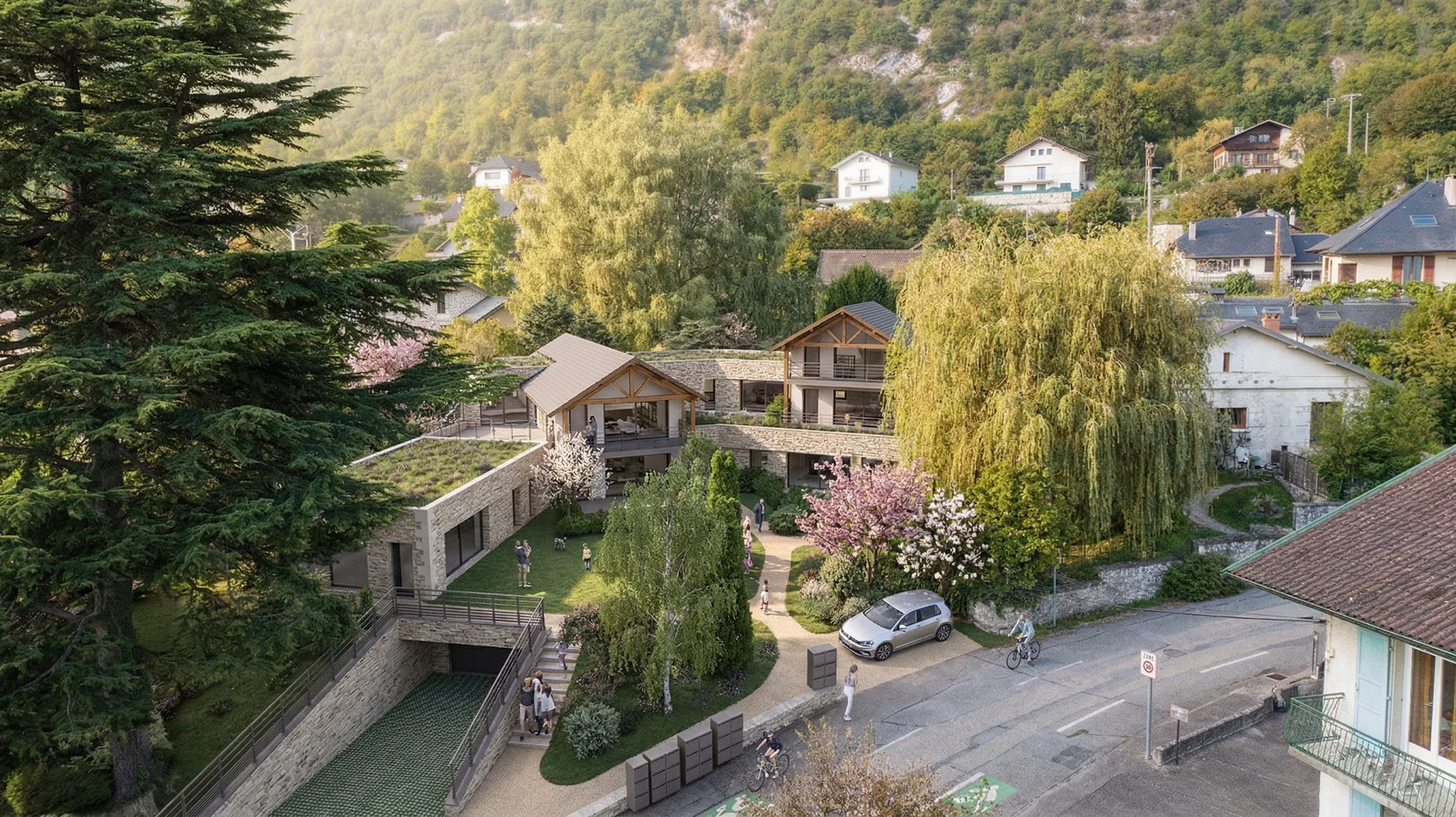
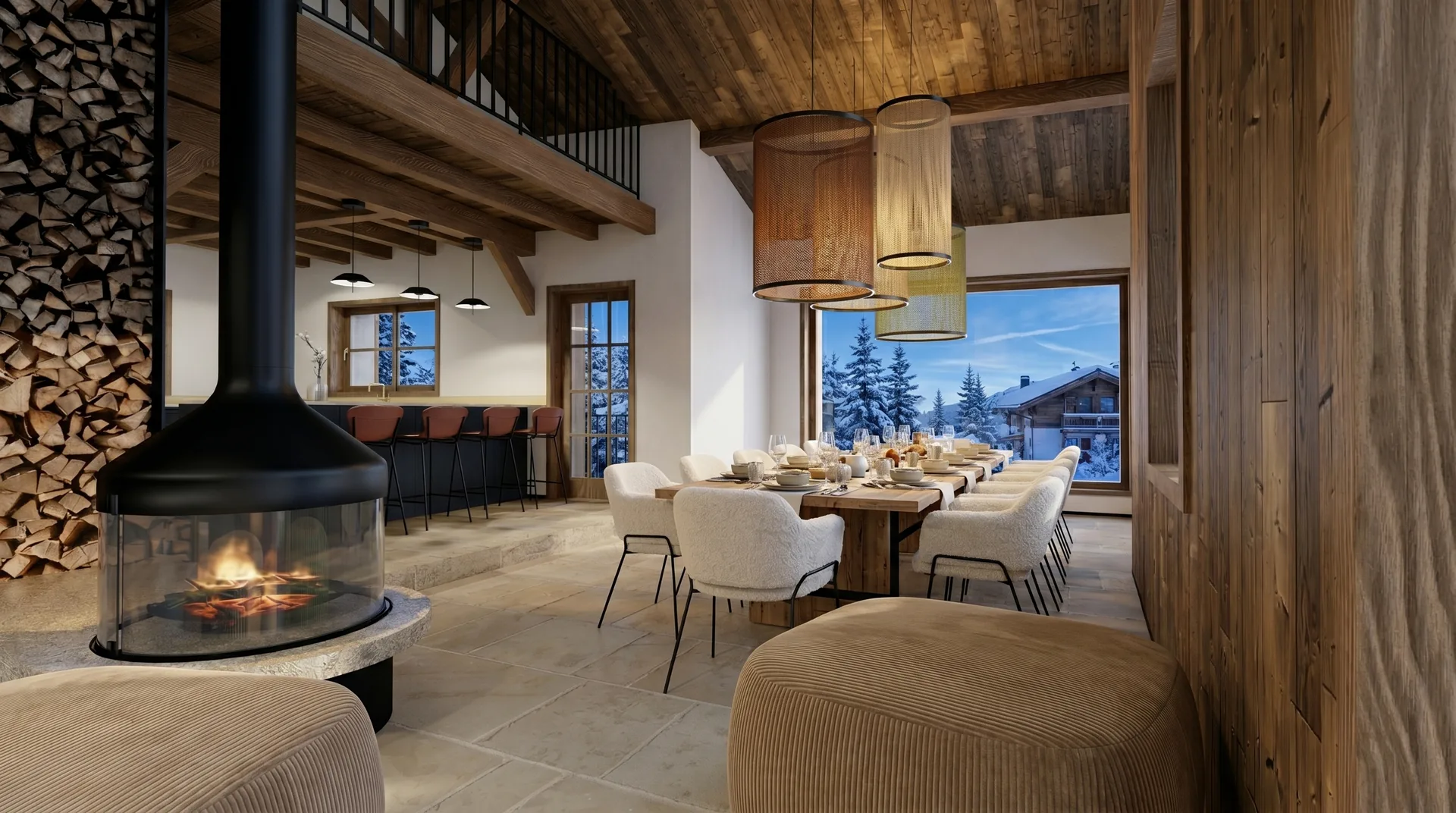
All projects →Renovations and new builds by our teams between Lac du Bourget and the Val d'Arly: so many insulated walls, each with the insulant that suited it.
How we choose the insulant for a project
The material comes last: first the wall, its substrate and the performance to achieve.
Survey of the wall
Nature of the substrate, signs of damp, available height, flues and services: everything that rules out certain insulants from the outset.
R and thickness calculated
The wall's threshold, then the thickness needed for each possible insulant, based on the λ in the data sheet.
Product named on the quote
Brand, reference, λ, thickness and certificate number written line by line, so that two offers can genuinely be compared.
Water vapour controlled
Vapour barrier or vapour retarder chosen together with the insulant, joints and penetrations included: this is where defects arise.
Fire protection
Clearances around flues, spotlight covers and boxes: provided for on the quote whenever the insulant is combustible.
Installation by our teams
Our salaried plasterboard fitters, carpenters and masons install the insulant they helped choose themselves.
Find out more
Where we come to advise on insulation
We survey your walls before recommending a material, throughout Savoie and Haute-Savoie.
Frequently asked questions · Choosing your insulation
The right insulant,
wall by wall.
Free visit, thickness calculation and itemised quote: the product, its λ and its certificate written on every line.