Redoing
walls and ceilings.
A wall that cracks, a ceiling that sounds hollow, a partition to knock down: redoing walls and ceilings means running demolition, services, plastering and painting in the right order. Here are the six stages of the job, what is decided at each, and our prices per m² taken from our quotes in Savoie and Haute-Savoie.
Freshen up or redo: the question to ask first
Before talking about price, you need to know what is being redone. Repainting sound walls has nothing in common with a job where a partition is knocked down, a cold wall is lined and a cracking ceiling is brought down. In the first case, the budget is counted in paint per square metre. In the second, four trades follow one another in the same room — demolition, services, plastering, painting — and the order in which they come in matters as much as the price of each.
This guide follows the job in its real order, from the survey to the last coat, with at each stage what is decided and what it costs. The prices come from our own quotes: they are taken from the demolition, plastering and painting lines of our 2024-2026 jobs in Savoie and Haute-Savoie, and given as ranges.
Stage 1: reading the walls and ceilings before pricing
Cracks. A fine network of cracks on an old render, or a straight crack along a plasterboard joint, is treated on the surface: it is opened up, filled and covered with a tape. A crack that runs through the wall, forms a staircase pattern in the masonry or widens from one season to the next signals movement in the structure. Filling it is pointless until the cause is understood: this is when the architect looks at the building, before the plasterers come in.
Damp. A stain at the foot of a wall, powdery saltpetre, paint blistering behind a wardrobe: three signs that rule out closing the wall straight away. A lining fitted against damp masonry hides the problem for a few months, then moves it — mould behind the board, wet insulation. The origin is looked for first (rising damp, infiltration, condensation), it is dealt with, and only then is the finish chosen. Our guide to insulating your walls from the inside covers this point for old walls.
Old plasterwork. In pre-war apartment blocks and houses, ceilings are often plaster on timber lath. When they sound hollow or come away in sheets, there are three options: consolidate and keep them, which is essential when they carry cornices or mouldings; fit a new ceiling beneath; or remove them, which frees up a little height but produces a great deal of rubble and dust.
Asbestos and lead. For a building completed before 1 January 1997, the regulations (order of 16 July 2019) require asbestos to be searched for in the materials affected by the works before demolition. In a home built before 1949, lead is also searched for in old paintwork before it is sanded or stripped. These surveys are carried out before the final quote, because they can change the working method.
Stage 2: removal and demolition
Removal opens the job: wallpaper, panelling, old suspended ceilings, partitions that no longer serve a purpose. A partition made of plaster blocks or bricks is demolished; a plasterboard partition is dismantled. In both cases, what remains is protected — floors, joinery, staircase — and waste is cleared as the work proceeds, with the plaster set aside for its sorting stream.
On our quotes, the demolition of a partition, disposal included, falls between €25 and €35 excl. VAT per m² of partition. Watch the unit: it is a price per square metre of partition knocked down, not per square metre of home. And before touching a wall, you need to know whether it is load-bearing. A partition that supports a floor is no longer a partition, and the job changes in nature: see our guide to opening a load-bearing wall.
Stage 3: running the services before closing up
This is the stage that gets forgotten in budgets and regretted afterwards. Once the partition is built or the lining fitted, moving a socket, adding a light point or running a drain means reopening. On a well-run job, our electricians and plumbers run their conduits and pipes while the metal frame is still open; the plasterers close up only after them.
This is also the moment to decide on the lighting. Recessed spotlights in a suspended ceiling, wall lights, tracks: they are placed on the plan before the boards are fitted, not after.
Stage 4: partitions, linings and suspended ceilings
Plastering redraws the room. The partition separates two spaces: a metal frame, plasterboard on both sides and, most often, acoustic insulation between the two. The lining dresses an existing wall: bonded directly to a straight, sound wall, or fixed to a frame when the wall is uneven or when insulation is to be slipped behind it. The suspended ceiling hangs beneath the existing ceiling: it evens out flaws, hides ducts and can take insulation or spotlights.
In wet rooms, moisture-resistant boards are fitted; near a staircase or a plant room, fire-resistant boards may be required. These variants are priced as an extra over the base price.
The detailed prices, item by item, are in our guide to the price of plasterboard per m² fitted. The suspended ceiling has its own guide: price of a suspended ceiling per m².
Stage 5: tape, joint compound and skimming
Once the boards are up, the joints remain. The plasterers apply tape over every joint and corner, coat it in several passes and sand between each one: on our quotes, this treatment is included in the price of the partition or lining. On an old wall, the equivalent is called skimming (ratissage), a coat of plaster drawn across the whole surface to erase patches, holes and crazing.
The finish level is decided here, not at the moment of painting. A matt paint forgives a lot; a satin paint or raking light along a wall reveals every badly sanded joint. If you want perfectly smooth walls, say so before the quote: it requires an extra coat of compound and drying time.
Stage 6: preparing and painting, or choosing another finish
Painting starts with a primer coat, which evens out the absorption of the substrate, then comes the finishing paint. On a wall that is already painted and in good condition, preparation is limited to washing down, filling and sanding. On a papered wall, the paper must first be stripped, which weighs almost as much as the paint itself.
Other finishes exist: paintable glass-fibre lining on a tired substrate, wallpaper, decorative lime plaster, panelling in a chalet. Each has its price and its constraints. Our guide to the price of paint per m² details the finish levels and what is priced separately, such as doors and radiators.
The budget, item by item
Here are the ranges taken from our 2024-2026 quotes in Savoie and Haute-Savoie, supplied and fitted, for each item. Prices exclude VAT; the incl. VAT column applies the 10% rate for renovation work in a home over two years old.
| Item | What the price includes | Excl. VAT per m² | Incl. VAT per m² |
|---|---|---|---|
| Demolition of a partition | per m² of partition, disposal included | €25 to €35 | €28 to €39 |
| Plasterboard partition | 48 mm frame, one board per face, joints treated | €65 to €80 | €72 to €88 |
| Insulating lining on a frame | board, frame and insulation, joints treated | €75 to €90 | €79 to €95 (5.5%)* |
| Lining without insulation | to straighten a wall or hide ducts | €60 to €85 | €66 to €94 |
| Plasterboard suspended ceiling | on a suspended frame, joints treated | €75 to €115 | €83 to €127 |
| Wall painting | preparation and painting, substrates in good condition or needing repair | €25 to €40 | €28 to €44 |
| Ceiling painting | preparation and painting | €27 to €45 | €30 to €50 |
| Wallpapered walls | paper stripping, preparation and painting | €42 to €51 | €47 to €56 |
* 5.5% rate when the lining meets the energy renovation criteria; otherwise 10%, i.e. €83 to €99 incl. VAT.
Example: a 12 m² bedroom. With a 2.50 m ceiling height, a 4 × 3 m room has about 30 m² of walls once the door and window are deducted, and 12 m² of ceiling. Freshening it up — painting the walls and ceiling on sound substrates — comes to about €1,100 to €1,750 excl. VAT. Redoing it — a new suspended ceiling, insulating lining of the two external walls (about 16 m²), then painting throughout — comes to around €3,200 to €4,600 excl. VAT. The difference comes almost entirely from the plastering.
VAT. In a home completed more than two years ago, this work is in principle subject to the 10% rate, and an insulating lining may qualify for 5.5%. The conditions are explained in our guide to VAT on renovation work. To place these items within the budget of a complete renovation, see also the cost of a house renovation per m².
Timescales: what makes the job last
The area matters less than the waiting times. The services must be run before the boards close up; the tape and compound must dry before sanding, and sanding must precede painting; a damp wall must dry before being lined, sometimes for weeks. An old ceiling to be consolidated also adds its own drying time.
To give an order of magnitude, a partial flat renovation that includes repainting takes between 4 and 8 weeks with us. A single room goes much faster; the exact schedule is set room by room during the visit, once the substrates have been seen.
In Savoie and Haute-Savoie: three interiors, three jobs
Apartments in old town centres — Chambéry, the old town of Annecy, the centre of Aix-les-Bains — combine plaster ceilings on lath, cornices to preserve and walls that are never plumb. We keep what has character and line the rest.
Houses from the 1960s to the 1980s have partitions of plaster blocks or bricks and poorly insulated external walls. It is often the right moment to line the cold walls at the same time as the finishes are redone, rather than repaint a wall that will have to be reopened later.
Chalets and mountain houses mix panelling, exposed timber and plasterboard. Replacing dark panelling with a painted plasterboard ceiling changes the light in a room; conversely, a timber ceiling that is kept is renovated by sanding and stain rather than by paint.
Our recent interior renovations
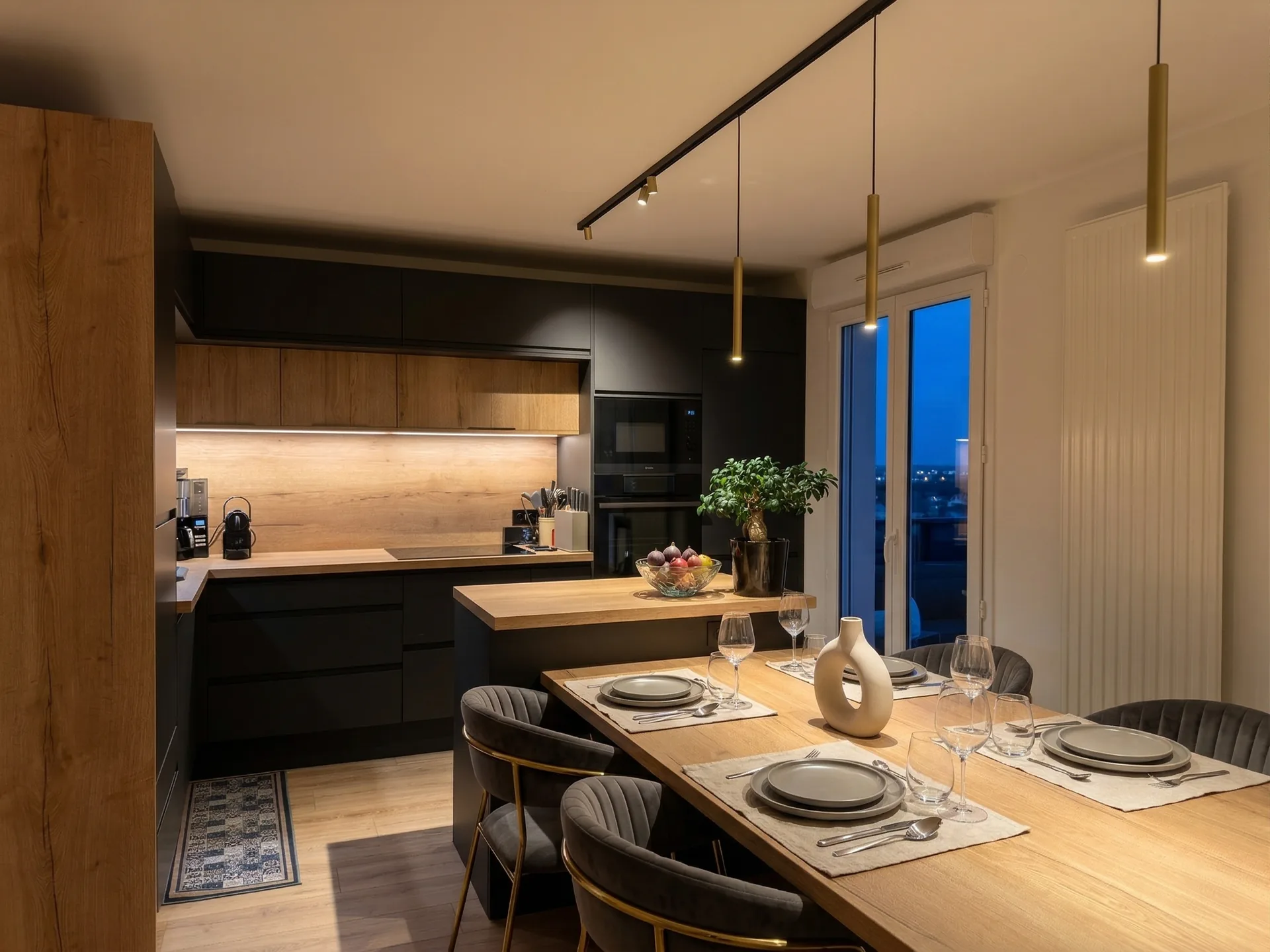
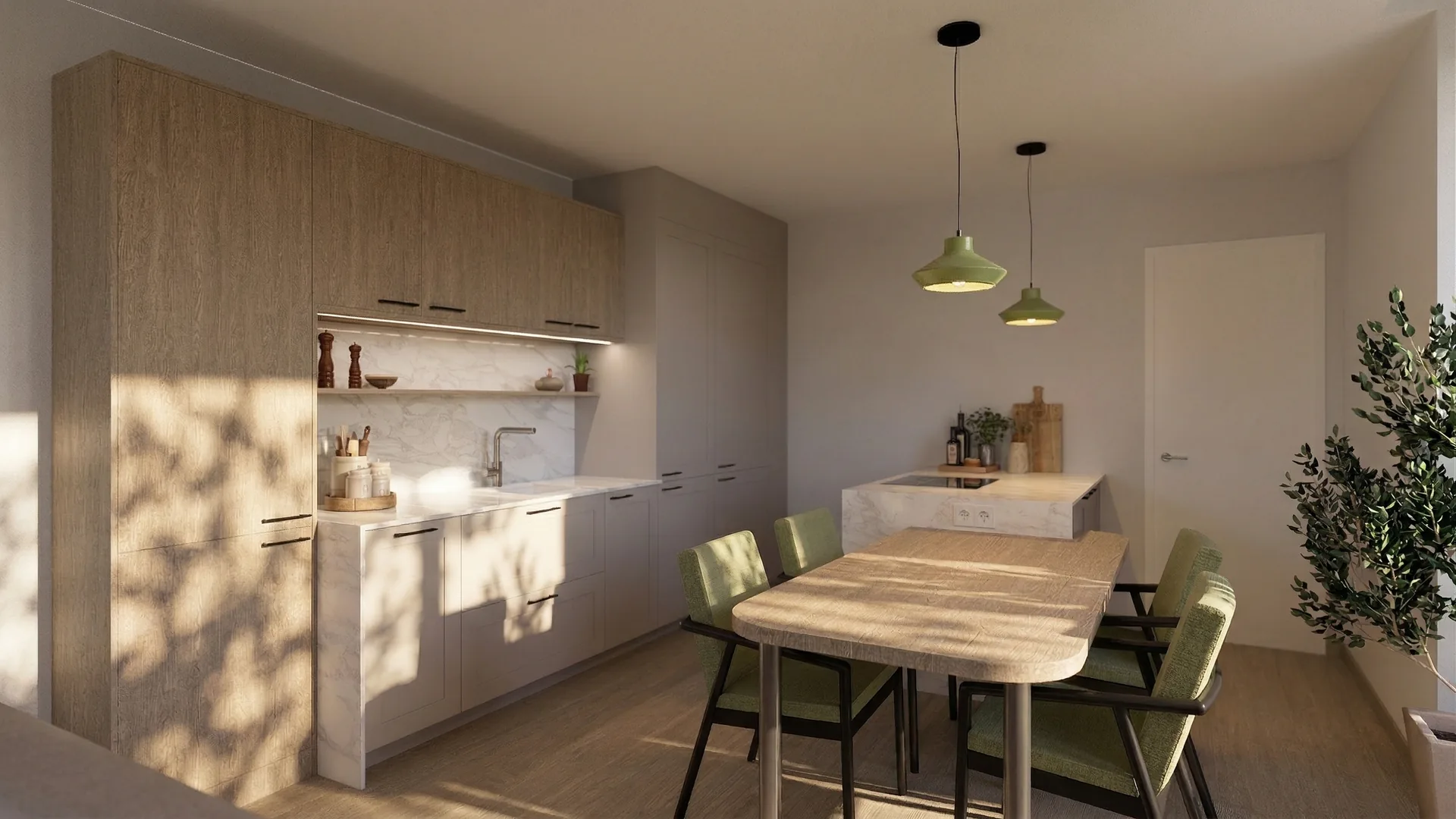
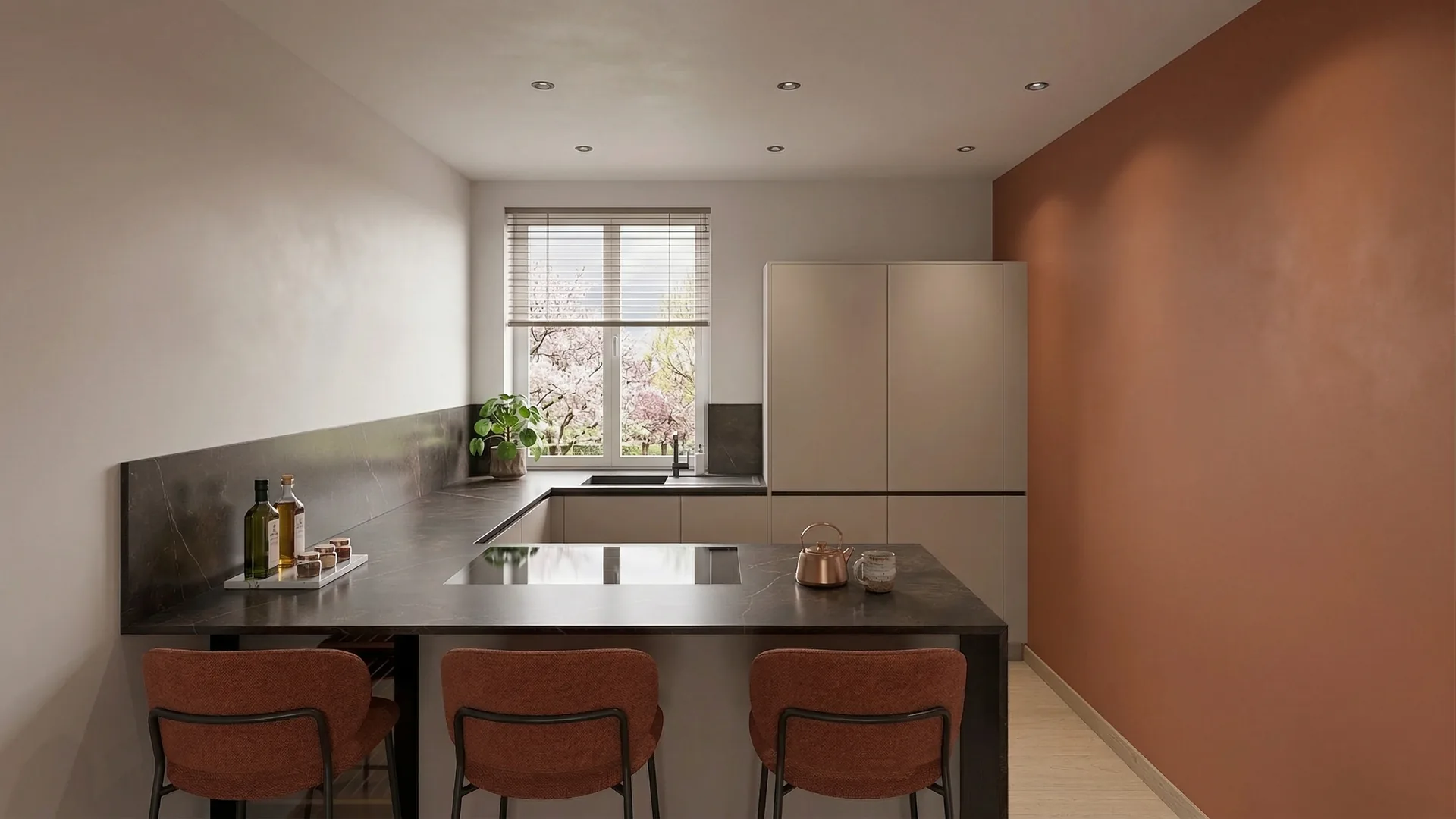
All projects →Three flats and houses renovated by our teams, from Aix-les-Bains to Chambéry and the north of Lac du Bourget.
How we carry out your wall and ceiling work
A visit, a take-off, a quote item by item, then our own teams in the order of the job.
Visit and take-off
We measure walls and ceilings on site, room by room, and look at the condition of the substrates: a price per square metre cannot be given from a photo.
Survey of the substrates
Cracks, damp, old plasterwork, asbestos and lead surveys when the age of the building requires them: whatever could change the method is seen before the quote.
Item-by-item quote
Demolition, services, plastering, compound, painting: each item is priced separately, by area, so it can be compared line by line.
Ducts and pipes first
Our electricians and plumbers work within the frames while they are still open; the boards are closed only after they have been through.
Plastering and painting
Our plasterers build partitions, linings and ceilings and treat the joints; our painters prepare the substrates and paint.
Handover and snagging
Walls and ceilings are checked in raking light before the last coat, and any corrections are made before the keys are handed over.
Find out more
- Cracks in a ceiling: are they serious?
- Saltpetre on a wall: causes and treatment
- Mould in the bathroom: the solutions
- Damp walls: what to do?
- Electrical renovation: prices and steps
- Cost of plasterboard per m² installed
- Cost of painting per m²
- Insulating your walls from the inside
- Load-bearing wall: before knocking it down
- VAT on works: 5.5 or 10%
- Renovation cost per m²
- Request a free quote
Where we redo walls and ceilings
Visit, take-off and quote from our offices in Aix-les-Bains and Annecy, across the two Savoie départements.
Frequently asked questions · Walls and ceilings
Clean walls,
straight ceilings.
Free visit, take-off and quote: every item priced separately, from demolition to the last coat of paint.