Hemp
insulation.
Hemp insulates in two forms that have almost nothing in common: a wool in boards or rolls, fitted like any wool, and a concrete or render of hemp shiv and lime, which is poured, sprayed or built in blocks. The first insulates at a low thickness; the second mainly provides mass and regulates moisture. Here is what a manufacturer's data sheet and the sector's documents say, figure by figure.
Wool or concrete: two materials under one name
The plant supplies two materials to building. The fibre of the stem is used to make insulating wools and felts. The hemp shiv (chènevotte), the woody core of the stem, mixed with lime, gives hempcrete and hemp renders. When a craftsman talks to you about "hemp insulation", the first question to ask is therefore: which of the two?
The wool comes in boards or rolls, often blended with other plant fibres, and is fitted like any wool, with no particular training. The one whose data sheet we read, Biofib'Chanvre, contains 90% hemp fibre, a polyester binder (or PLA as an option) and a 0.2% fungicidal treatment: mostly bio-based, but not 100% plant-based.
Hempcrete is poured between shuttering, sprayed by machine, or delivered as prefabricated blocks laid in lime mortar. Richer in lime, the render is applied by trowel in several coats, at 2 to 6 cm, to correct a wall thermally or to finish it. Cork, another plant-based insulation, has a separate guide in this series.
Hemp wool: thicknesses and thermal resistance
The manufacturer's data sheet states a conductivity of 0.040 W/(m·K), measured to standard EN 12667, for a density of 40 kg/m³ in board form and 30 kg/m³ in roll form. The thermal resistance of a layer is calculated by dividing its thickness by this conductivity; the data sheet gives the values, board by board.
| Board thickness | Thermal resistance R (data sheet) | What it covers |
|---|---|---|
| 45 mm | 1.12 m²·K/W | Partition infill, acoustic correction |
| 100 mm | 2.50 m²·K/W | Supplement to existing insulation |
| 140 mm | 3.50 m²·K/W | Just under the wall threshold (R = 3.7) |
| 160 mm | 4 m²·K/W | Wall insulated beyond R = 3.7 |
| 200 mm | 5 m²·K/W | Maximum thickness of the range in a single board |
Set against the thresholds in our guides by element, these values give thicknesses that are easy to remember: nearly 15 cm for a wall at R = 3.7, i.e. the 160 mm board (see our guide to insulating walls from the inside), 24 cm under a rafter slope at R = 6, in two crossed layers (see insulating your roof from the inside), and 28 cm in unconverted lofts for R = 7.
The data sheet lists the uses: converted lofts between and under rafters, unconverted lofts with rolls unrolled, lining of walls, partitions, ceilings and floors, timber-frame houses and external insulation. It also states that the rolls and the 200 mm board are not covered by the product's European technical approval: a detail to check if your project relies on these formats.
On noise, two systems are quoted: more than 42 dB of sound reduction for a 72 mm partition filled with 45 mm of hemp between two plasterboards, and more than 56 dB for a timber-frame wall filled with 140 mm, with a decoupled board. These values apply to the wall described, not to the insulation alone.
Hempcrete and hemp render: a different trade
According to the association Construire en Chanvre, the conductivity of hempcrete ranges from 0.06 to 0.19 W/(m·K) for mixes of 200 to 1,000 kg/m³: the heavier the mix, the less it insulates. Even at the best end of this range, a wall at R = 3.7 needs about 22 cm of concrete. A 6 cm render, for its part, tops out at R = 1 in the most favourable case: it is a thermal corrector, not insulation in the sense of the grant thresholds.
This work falls under the professional rules for executing hempcrete works, drawn up by Construire en Chanvre, validated by the Agence Qualité Construction in 2012 and updated in 2024. Insurers treat them as standard techniques, on four conditions: certified hemp shiv, a validated binder-aggregate pairing, a company trained by an approved trainer, and compliance with the rules themselves. Without the training, the company is not insured for this work: it is the first document to ask for from anyone quoting you for hempcrete or hemp render.
That leaves the schedule. A poured or sprayed concrete contains water and must dry before the finishes: this time is planned from the outset. Prefabricated blocks, dried in the factory, avoid this wait. In new build, the concrete most often fills a timber frame; in renovation, it is used as an internal lining, as described in the professional rules.
Wool, concrete or render: which for which project?
| Hemp wool | Hempcrete | Lime-hemp render | |
|---|---|---|---|
| Form | Boards or rolls | Cast in shuttering, sprayed or in blocks | By trowel, 2 to 6 cm |
| Conductivity | 0.040 W/(m·K) | 0.06 to 0.19 W/(m·K) depending on the mix | Higher in lime than the concrete |
| For a wall at R = 3.7 | Nearly 15 cm | About 22 cm at best | Does not reach it (R ≤ 1 with 6 cm) |
| Installation | Dry fitting, like any wool | Trained company, drying time to allow for (except blocks) | Trained company, several coats |
| Uses | Walls, rafter slopes, lofts, partitions, timber frame | Frame infill in new build, internal lining in renovation | Thermal correction and finish of an old wall |
For an ordinary renovation, wall, rafter slope or loft, the wool does the job of an insulation, with thicknesses comparable to those of cellulose wadding or a mineral wool. Concrete and render answer a different demand: mass and a wall that exchanges moisture with the room, at the cost of greater thicknesses or lower performance. Our guide Which insulation to choose? places hemp among the other families, wall by wall.
Water vapour: why hemp suits old buildings
The wool consulted lets vapour through almost without resistance: μ = 1, i.e. an equivalent air thickness (Sd) of 0.05 m for 45 mm and 0.20 m for 200 mm. The sector, for its part, presents hempcrete and lime-hemp renders as breathable, able to store and then release moisture, and respectful of the moisture exchanges of old buildings.
On a stone, cob or rubble wall, this is exactly what is wanted: masonry that keeps drying towards the inside. With a wool, the rule remains the one we apply to any vapour-open insulation: a humidity-variable vapour retarder rather than a waterproof vapour barrier, and continuous airtightness. The render, for its part, is applied directly to the wall, with no frame or membrane.
Summer comfort: mass makes the difference
What delays the heat of a summer afternoon is the amount of heat a wall can store: density multiplied by heat capacity. For the wool consulted, 40 kg/m³ at 1,800 J/(kg·K), this gives about 72 kJ per m³ per degree: barely more than a dense rock wool, and nearly five times less than a rigid wood fibre board, according to the table in our guide Which insulation to choose?. If summer comfort under a roof is your priority, wood fibre therefore deserves the comparison.
Hempcrete weighs 200 to 1,000 kg/m³, i.e. 5 to 25 times the mass of a hemp wool board: it is this mass that the sector highlights for inertia. We do not repeat the "hours of time lag" published by manufacturers and the sector: they are calculated for a specific wall and cannot be transposed to yours.
Fire, pests, settlement: what the documents say
Fire. The wool consulted is classed F, "not tested", and its maximum service temperature is 120 °C: it is fitted behind a facing, the sector pointing out that hemp fibre materials are not meant to be left exposed, with the regulatory clearances around flues. For lime-hemp render, Construire en Chanvre states a reaction to fire of A2-s1,d0.
Rodents and insects. The manufacturer and the sector stress that the fibre, which contains no protein, attracts neither rodents nor moths, and that the lime protects the concrete. We cite this as their argument, without feedback from our own sites.
Settlement. The data sheet states boards with no vertical settlement, thanks to a lateral "spring effect", and advises cutting them about 2 cm wider than the stud spacing so as to fit them under slight compression. As with cellulose wadding, this is a point checked at fitting, not only on paper.
Environmental balance
France is Europe's leading hemp producer, with more than 21,700 hectares cultivated in 2022, of which about 23% went to building, according to the CD2E. Construire en Chanvre describes a crop grown without plant protection products or irrigation. It also cites a 2005 life cycle analysis by INRA: 1.7 kg of CO₂ equivalent stored per kilo of fibre, 1.9 kg per kilo of hemp shiv.
These figures are dated; for a specific product, up-to-date environmental declarations (FDES) can be consulted on the INIES database. Also bear in mind that the wool contains about 10% binder and additives, which also count in its balance.
And the price?
None of the 6,053 lines in our 2024-2026 quotes concerns hemp. We therefore publish no price: a figure with no site behind it would be an invention, and prices found on the internet rarely specify what they include. For comparison, the fitted prices of mineral wools, wood fibre and cellulose wadding, taken from our quotes, appear in our guides in this series.
On a real project, hemp wool is priced like any board wool: frame, insulation, vapour retarder and plasterboard, fitted by our salaried plasterers. We will also tell you frankly if another material suits your wall, your available space or your budget better.
Some sites by our teams
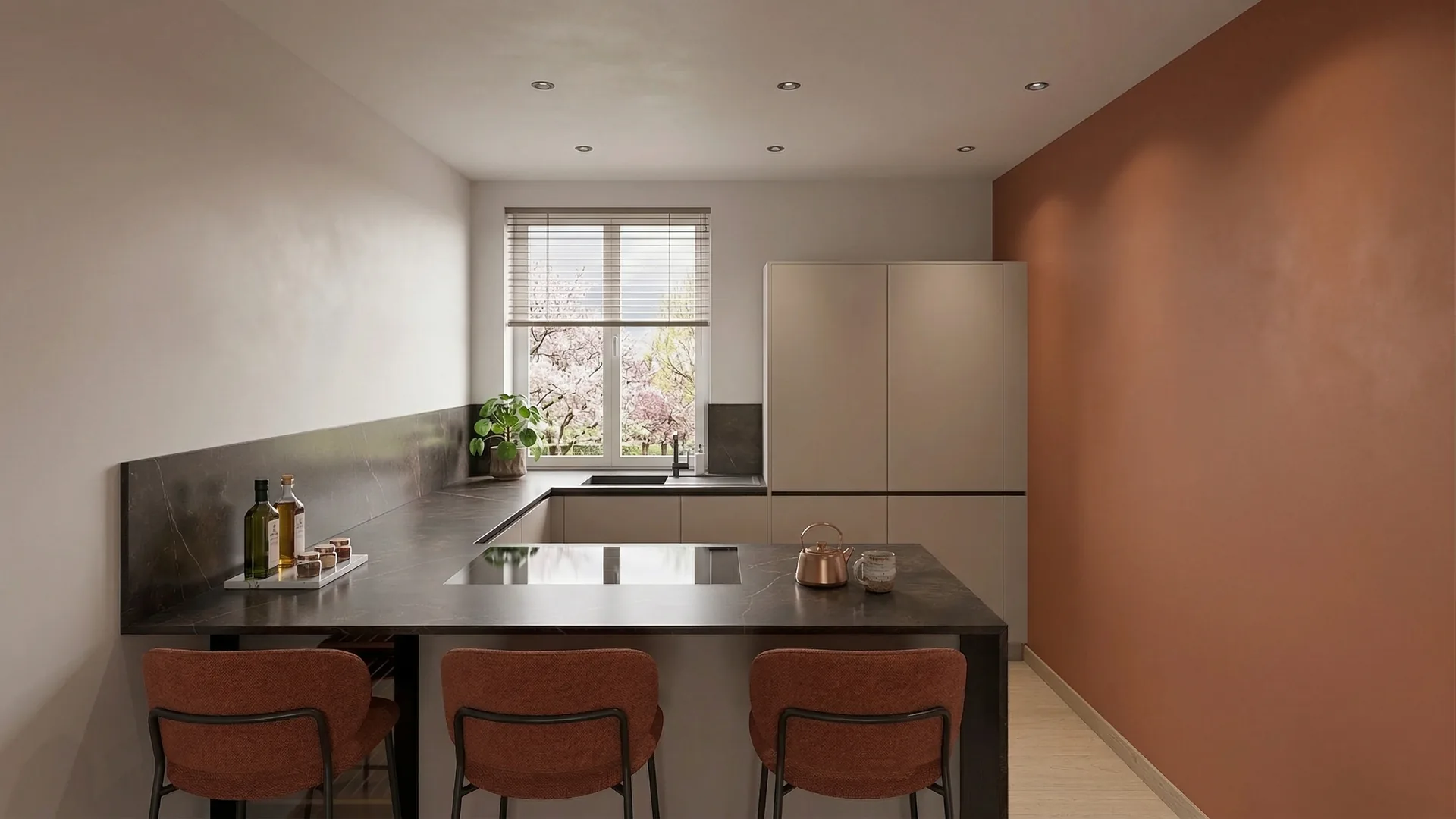
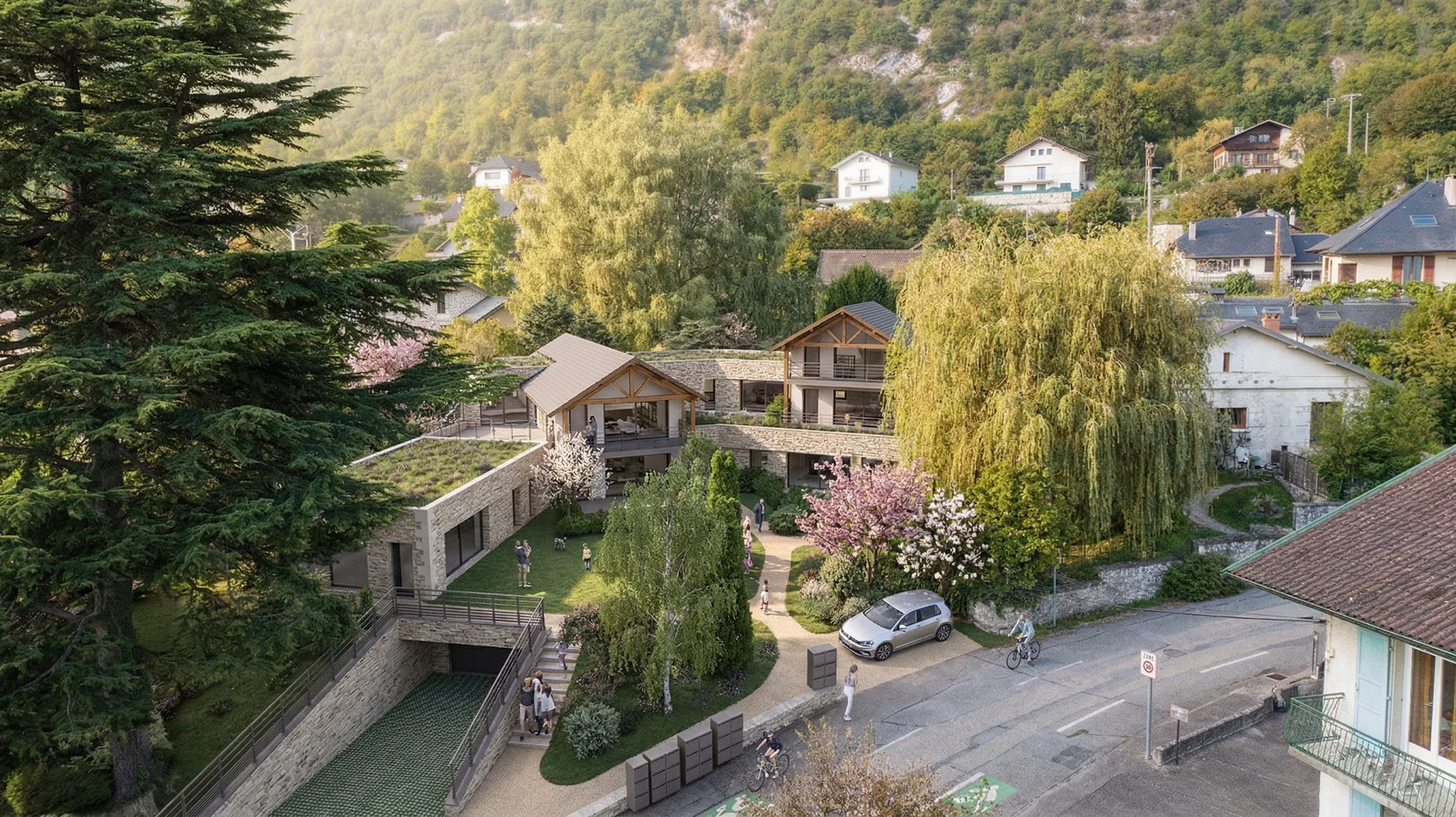
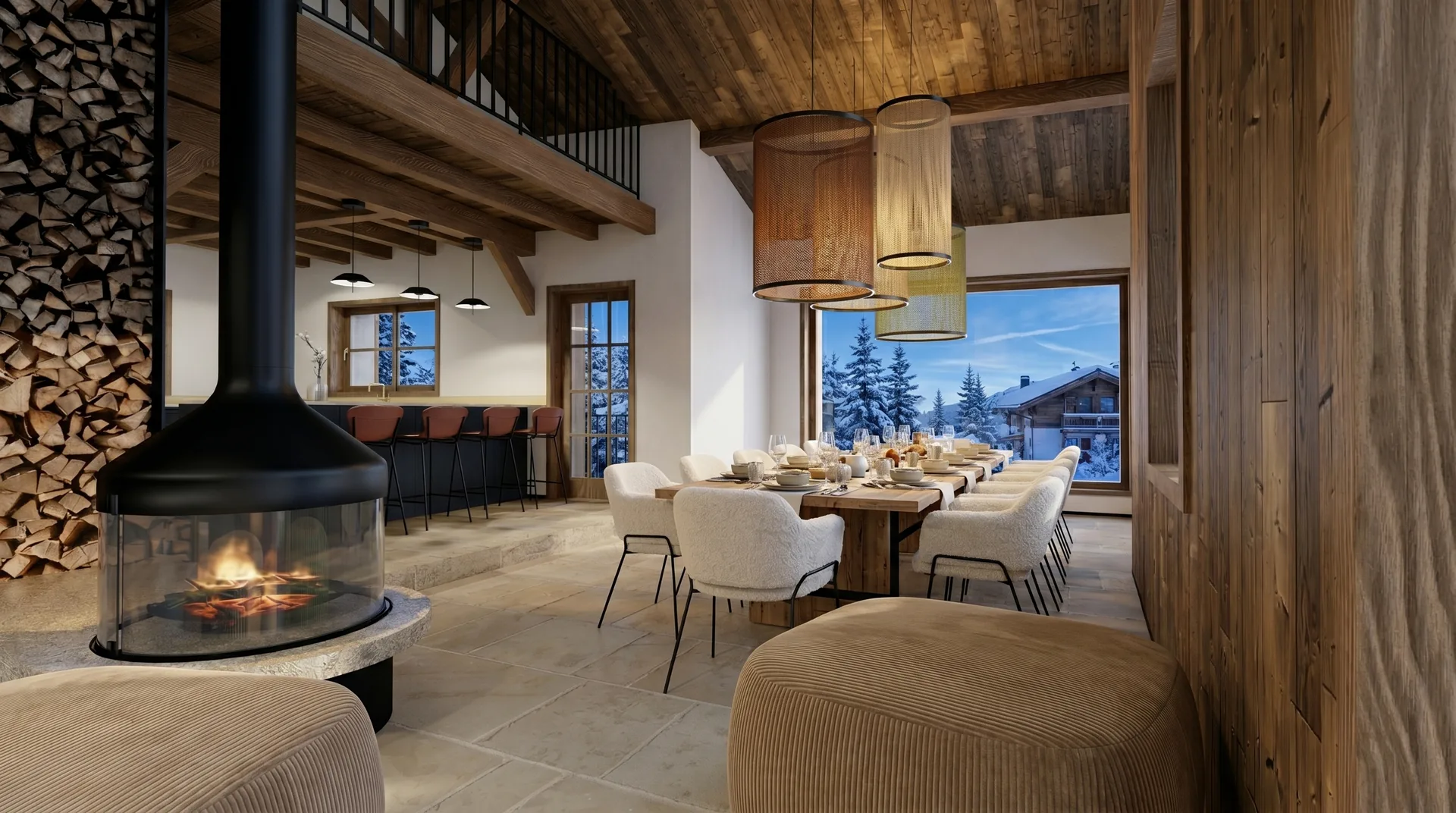
All projects →A few recent sites by our teams in Savoie, from the renovation of a house to the construction of a block of flats.
How we choose the insulation for a wall
Hemp is only one option among others: the substrate and the available space decide.
Reading the substrate
Stone, cob, concrete or frame; moisture at the base of the wall, condition of the timber. The substrate dictates the vapour management before the choice of material.
Target resistance
We set the R of each wall, then the thickness follows from the conductivity of the chosen product, backed by its data sheet.
Vapour and airtight junctions
Humidity-variable vapour retarder on an old wall, continuity of the junctions around windows and doors, ducts and boxes.
Priced comparison
Wools, wood fibre, cellulose wadding: we compare the solutions with the real prices from our quotes, not with catalogue prices.
Fitted by our plasterers
Our salaried plasterers fit the frame, insulation, vapour retarder and plasterboard themselves, then our painters take care of the finishes.
Grants and whole-home renovation
In a whole-home renovation offer, our RGE CertiRénov certification (no. CR-2026-73-0095) gives access to grants, subject to performance conditions.
Find out more
- Choosing an insulation, family by family
- Wood fibre: uses and prices
- Cellulose wadding in detail
- Mineral wools: glass or rock
- Lining and insulating an old wall
- Insulating under the rafters
- Unconverted lofts: thicknesses and grants
- Reduced VAT on insulation works
- What our RGE certification covers
- Request a free visit
Where we insulate
Visits and insulation quotes from our offices in Aix-les-Bains and Annecy, across the two Savoie départements.
Frequently asked questions · Hemp insulation
An insulation chosen
for your wall.
Free visit and quote: we look at the substrate, the available space and the water vapour before proposing a material.