Cork
insulation.
Expanded cork has a flattering reputation: natural, rot-proof, pleasant in summer. The technical data sheets confirm some of these qualities and qualify others. This guide compares its real figures with those of other insulation materials, wall by wall, and says where we offer it — and where we prefer something else.
Expanded cork, how it is made
Cork is the bark of the cork oak. According to the manufacturer Secil's data sheet, its harvesting is part of the tree's life cycle: it is a renewable material, which does not require felling.
To make an insulation material from it, cork granules are steamed in an autoclave at around 300 °C according to the terminology sheet of the Office québécois de la langue française. The grains swell and release their natural resin, suberin, which binds them together: no binder is added. The resulting block, black in colour, is cut into boards; it also exists as loose granules.
The Amorim data sheet consulted (May 2026) states cork as the only raw material, boards of 1,000 × 500 mm and thicknesses up to 300 mm. The Secil sheet runs from 20 to 100 mm, with other thicknesses available on request.
Its performance, according to the manufacturers' data sheets
We recorded two data sheets for boards intended for façades. These are manufacturers' values, established according to the European test standards they cite; the only value certified by an independent body is the ACERMI conductivity of the Amorim board.
| Characteristic | Amorim board (May 2026 data sheet) | Secil Isovit ICB board (March 2019 data sheet) |
|---|---|---|
| Conductivity λ | 0.039 W/(m·K) measured; 0.040 certified by ACERMI | ≤ 0.040 W/(m·K) |
| Density | 110 ± 10 kg/m³ | ≤ 130 kg/m³ |
| Specific heat | 1,560 J/(kg·K) | not stated |
| Resistance to water vapour | μ 20 (at 60 mm) | not stated |
| Reaction to fire | Euroclass E | Euroclass E |
| Compression at 10% strain | ≥ 100 kPa | ≥ 100 kPa |
| Water uptake, short immersion | < 0.5 kg/m² | ≤ 0.5 kg/m² |
On conductivity, cork sits with rigid wood fibre boards (0.038 for the one cited in our guide to wood fibre). At equal thickness, it insulates slightly less than the mineral wools consulted, between 0.032 and 0.035. Our comparison "which insulation to choose" places all these families side by side.
What thickness for each wall
The Amorim data sheet gives the thermal resistance R of each thickness directly. Here are the ones that cross the thresholds required for grants, as our guides by element detail them.
| Element | Target threshold | Cork thickness | R stated by the Amorim data sheet |
|---|---|---|---|
| Lower floor | R ≥ 3 | 120 mm | 3.05 m²·K/W |
| Wall, from the inside or the outside | R ≥ 3.7 | 150 mm | 3.85 m²·K/W |
| Rafter slope or roof | R ≥ 6 | 240 mm | 6.15 m²·K/W |
This is its main limit: it needs space. For the same wall, our comparison counts about 8 cm of a polyurethane at 0.022, against 15 cm of cork. From the inside, every centimetre is taken from the room; on a façade, the thickness has repercussions on window sills, roof overhangs and the fixing of shutters. Polyurethane, the thinnest insulation in this series, has its own guide: polyurethane insulation.
Weight matters too: at 110 kg/m³, 15 cm of cork weighs about 16.5 kg per m² of wall. Nothing awkward on a masonry wall, but a point to check on a light frame or an old timber floor.
Moisture: an insulation that lets the wall dry
The μ factor measures a material's resistance to the passage of water vapour, relative to that of a layer of air (μ = 1). The cork consulted is at μ 20 at 60 mm: more closed than a mineral wool (1) or a wood fibre (2 to 5), but very far from extruded polystyrene (150), according to the data sheets gathered in our comparison.
It does not rot: the Secil data sheet and the Office québécois de la langue française both call it rot-proof, and both data sheets limit its water uptake in short immersion to 0.5 kg/m². On an old stone wall, which must be able to release the moisture it receives, this is a real asset — provided that the render or facing applied over it remains permeable too. Combined with a waterproof covering, the board loses this advantage.
Summer comfort: in the middle of the pack
What slows heat through a wall is the amount of heat the insulation can store: its density multiplied by its heat capacity. Calculated from the data sheets consulted:
| Insulation (data sheet consulted) | Heat stored per m³ per degree |
|---|---|
| Rigid wood fibre (STEICOtherm) | ≈ 336 kJ |
| Expanded cork (Amorim) | ≈ 172 kJ |
| Flexible wood fibre (STEICOflex 036) | ≈ 126 kJ |
| Dense rock wool (Rockplus Premium) | ≈ 67 kJ |
Cork thus stores about two and a half times more heat than a dense rock wool, and half as much as a rigid wood fibre board. We do not give a time lag in hours: the values published by manufacturers contradict each other, and the result depends on the whole wall, not on the insulation alone.
Where we offer it, and where we prefer something else
On a façade under render. Both boards consulted are designed for external insulation under render: their pull-off strength, at least 40 kPa for Amorim and 50 kPa for Secil, counts for the hold of the render. The board is not chosen on its own: adhesive, fixings, reinforced base coat and finish form a system, which must have its own technical assessment, European or French. It is this complete system that we check before proposing it. The other items of an insulated façade — scaffolding, reworking of sills, formalities at the town hall — are priced in our guide to the price of external insulation.
On the floor. Its compressive strength, at least 100 kPa at 10% strain, allows it to be used under a floor or a screed, within the limits that the manufacturer sets for the intended work. Our guide to ground floor insulation presents the other solutions and the R ≥ 3 threshold.
On an old wall, from the inside, when the wall needs to keep breathing: cork and wood fibre are the two candidates we weigh against each other. The guide insulating walls from the inside details thicknesses, framing and airtightness.
In unconverted lofts, on the other hand, we do not offer it: blowing in cellulose wadding or mineral wool is the usual technique there, and our guides to these two materials describe it.
The environmental balance, what can be verified
The expanded board contains only cork, with no added adhesive: this is the soundest point, written in both data sheets. Amorim also presents it as renewable, biodegradable and recyclable, and claims a negative carbon footprint by referring to its environmental declaration (EPD no. HUB-0281). We cite this last claim as the manufacturer's: we have not re-read the declaration itself.
This balance is read alongside the other criteria. A bio-based insulation fitted where it performs well is worth more than a material that is virtuous on paper but poorly suited to the wall.
The price: why we do not publish a figure
Our price guides are based on our own 2024-2026 quotes in Savoie and Haute-Savoie. None of them includes cork insulation: we therefore have no fitted price to give you, and we will not copy ranges found elsewhere without being able to verify them.
To put a project in context, here is what those same quotes say for comparable works. External insulation under render, in expanded polystyrene or rock wool, comes to €160 to €190 excl. VAT per m² of façade, of which €95 to €130 is for the bonded and fixed insulation. A wall lining in mineral wool on a frame costs €80 to €90 excl. VAT per m². Cork mainly changes the insulation line, and its thickness for equal performance: 130 mm of expanded polystyrene gives R = 4.20 in one of our quotes, whereas 170 mm of cork is needed for R = 4.35 according to the Amorim data sheet.
The 5.5% VAT applies to the insulation of a home completed more than two years ago, subject to performance conditions: our guide to VAT on works sets out the rules. If you are considering cork, we price it by quote, line by line, alongside a wood fibre or wool variant, so that the difference is clear.
Our projects around the lake
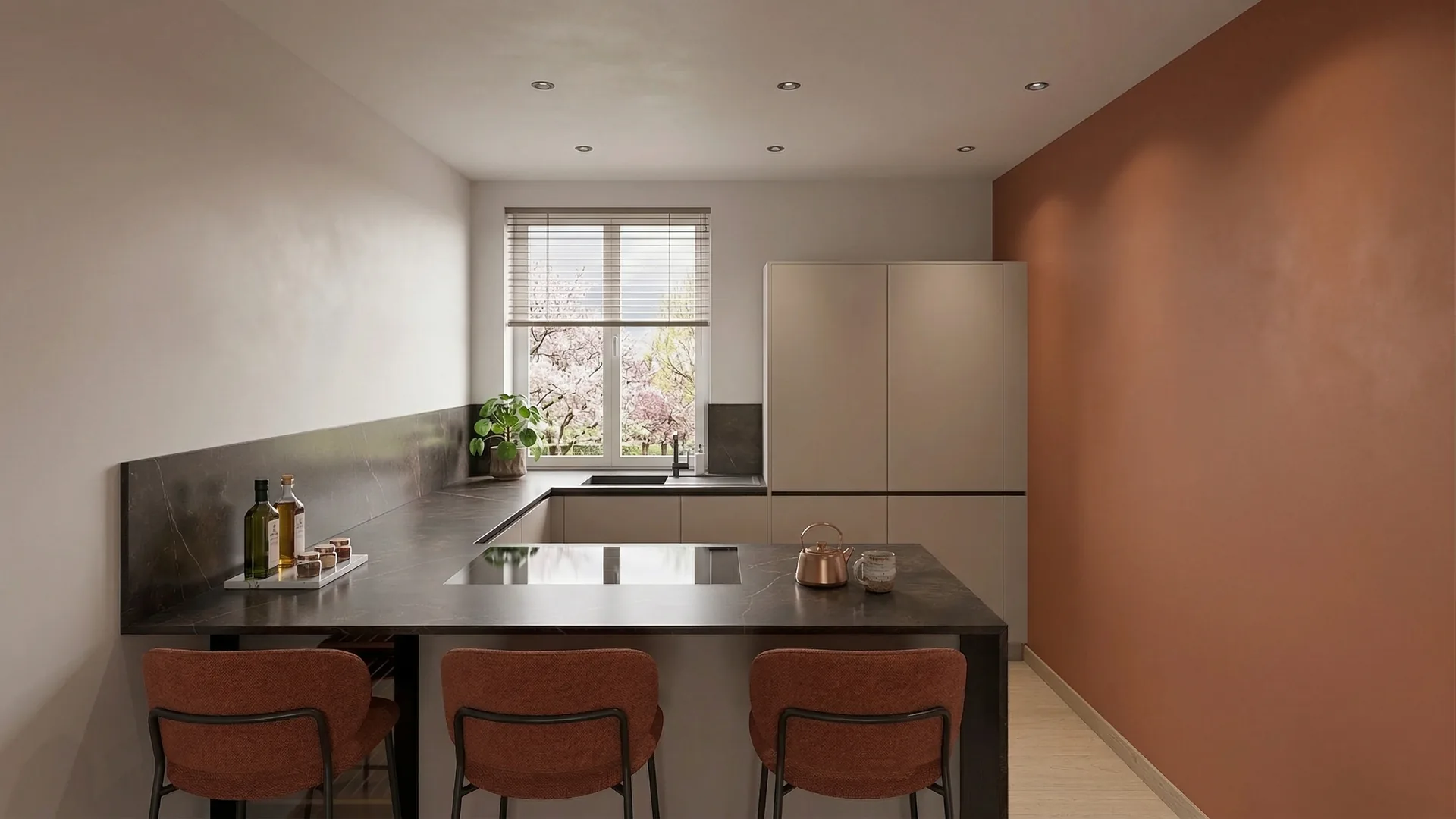
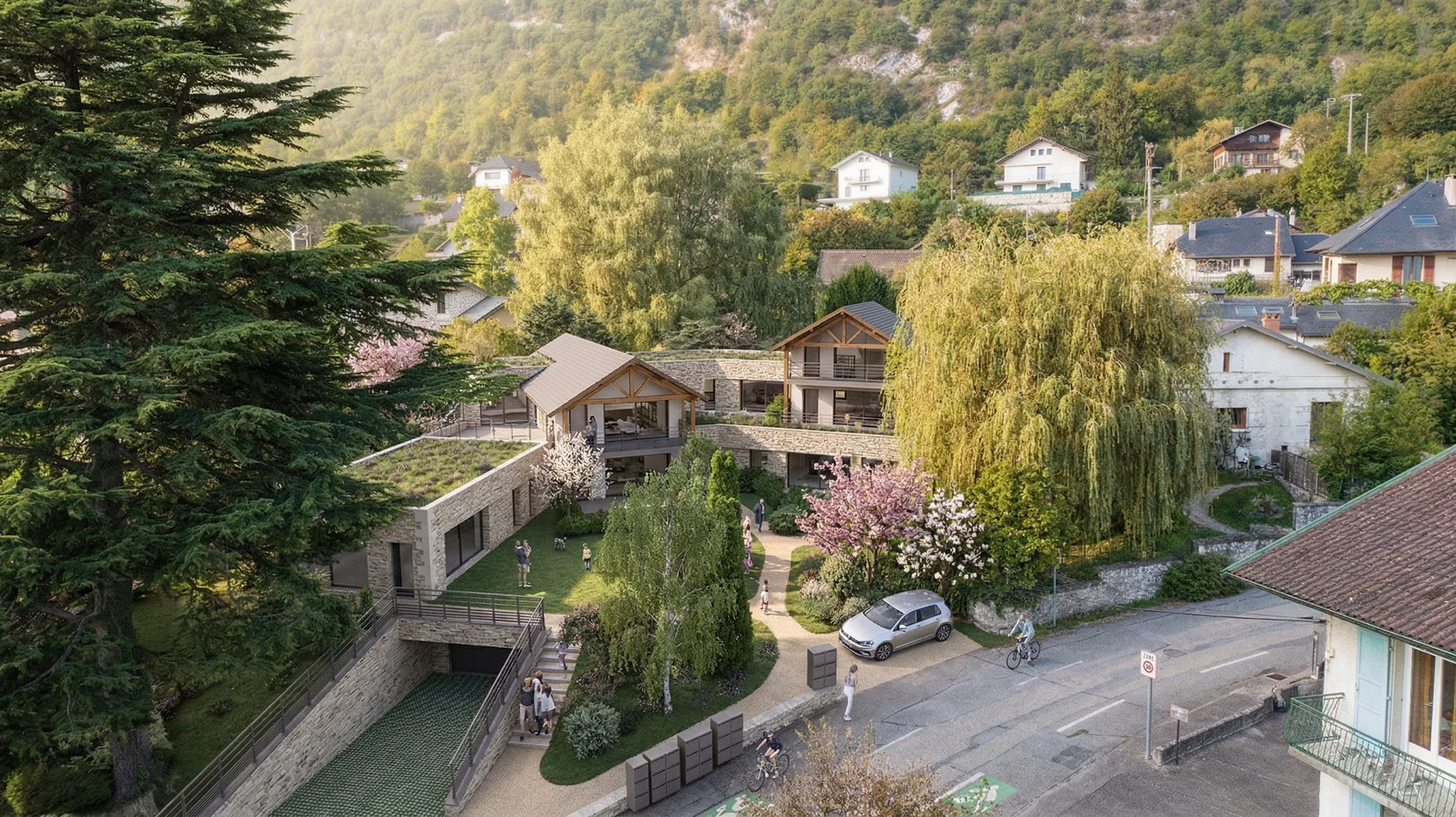
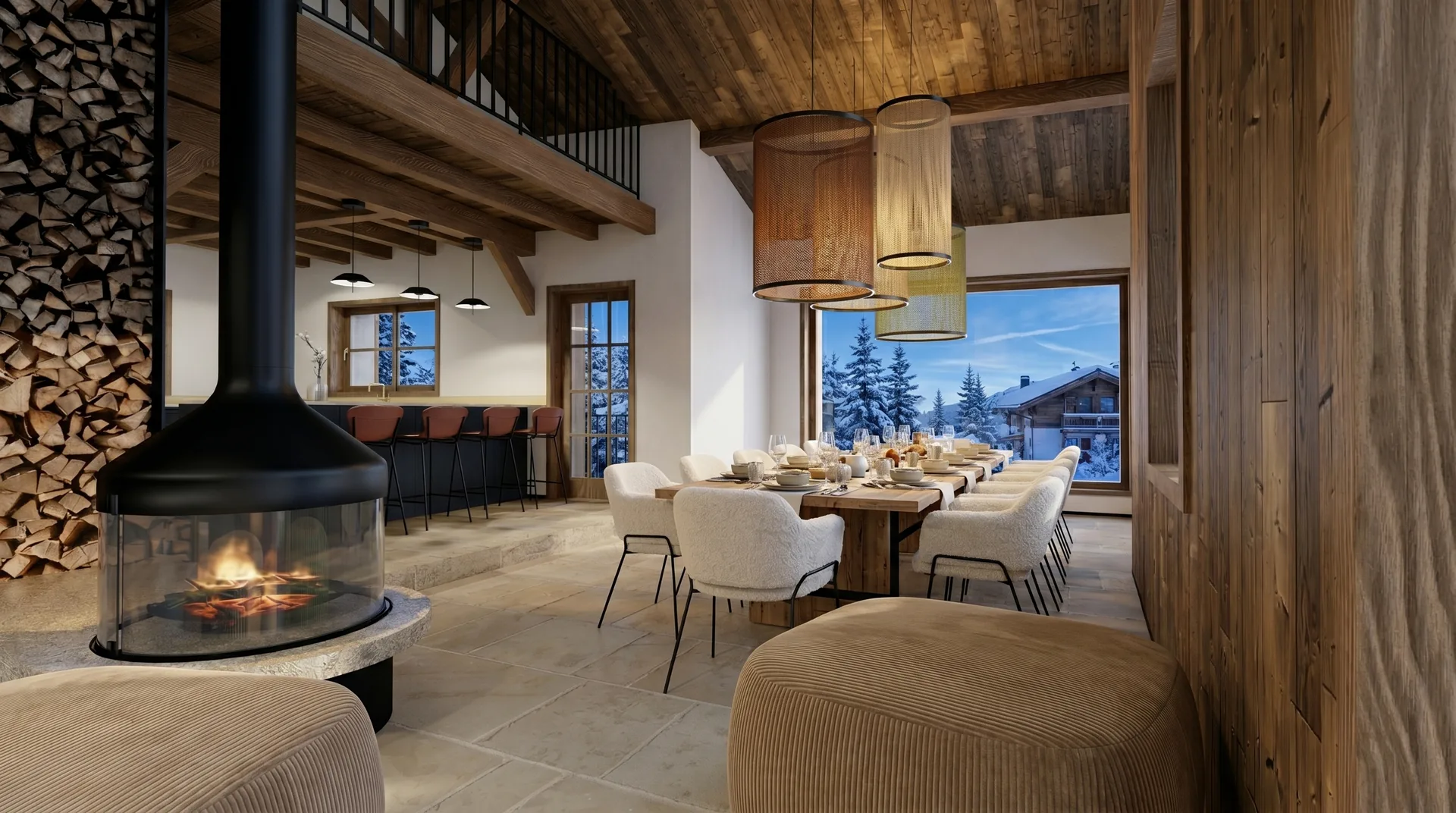
All projects →From our Aix-les-Bains office, our sites stretch from the shores of Lac du Bourget to the Val d'Arly. Here are some recent projects.
How we choose an insulation
The material is decided on the wall in question, not from a catalogue: survey, performance threshold, priced alternatives.
Survey of the wall
Nature of the wall, traces of moisture, available space, condition of the renders: what rules out certain insulation materials before we even discuss them.
Performance threshold
The target resistance R depending on the wall and the possible grants, translated into thickness for each material considered.
Priced options
Two or three insulation materials on the same quote, over the same scope, to compare like for like.
System verified
On a façade, the insulation, adhesive, fixings and render must form an assessed whole: we check it before proposing it.
Installation by our teams
Our salaried plasterers and façade specialists fit the insulation, the airtightness layer and the facing themselves.
Grants and VAT
Reduced VAT, CEE and éco-PTZ depending on your situation; MaPrimeRénov' only in a major renovation (rénovation d'ampleur).
Where we provide quotes
Visit, survey and insulation quote prepared from our offices in Aix-les-Bains and Annecy, across the two Savoie départements.
Frequently asked questions · Cork insulation
Compare insulation materials,
on your own wall.
Free visit and quote: we price several insulation materials side by side, fitted by our teams, so that the choice is made on figures.